Thursday, January 20, 2011

Bulldogs Aim to Take Care of Business

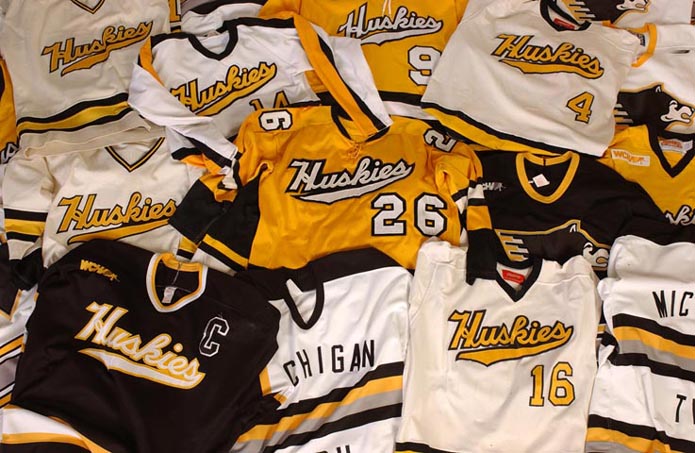
HOUGHTON, Mich. -- There are pluses to a trip like this.

Houghton isn't a terrible place at all. There are some really nice people in this town, including many of the folks we'll run into at the rink Friday and Saturday.

But for UMD, this has been a house of horrors.

Under Jamie Russell, Michigan Tech is 49-142-28 against WCHA teams. They are 9-16-5 against UMD.

In Houghton, the Bulldogs have had their share of struggles. Last year, they lost on Friday and had to rally from 2-0 down to win Saturday against a team that won just three games all year that weren't against UMD. In 2008-09, a six-win Tech team stole points in each series at the DECC, getting a Saturday tie each time.

UMD has not swept a two-game series in Houghton since Oct. 15-16, 2004, when they won 5-4 and 6-3. That's a long time ago, especially when you consider that Michigan Tech is UMD's "protected" rival in the WCHA, so they will play four against each other every year while the schedule rotates other teams on and off the "home and away series" list.

There is no real rational explanation for the troubles. Tech was 4-12 at home last year. Their only road win of the season was against UMD. They are 1-5-3 at home this year, with the win coming Oct. 15 against Minnesota State.

That's also the last time the Huskies won a game. They're 0-16-2 since.

Beset by injuries, Russell was left to recruit a player off campus recently. They got junior co-captain Brett Olson -- a Superior native -- back, but he's not going to solve it all by himself, no matter how well he plays.

You want to know what the problem is right now? Check these stats out.

UMD's 12 juniors and seniors have combined for 55 goals and 139 points this season, which accounts for 69 percent of UMD's goals and 64 percent of their points.

Michigan Tech has ten juniors and seniors (Eric Kattelus is no longer on the team, so only nine of them are active). They have a total of 17 goals and 45 points among them, accounting for 31 percent of each. The Huskies have 29 goals and 69 points out of their freshmen, which is more than half their goal total and nearly half the points.

That bodes well for Tech's future, because it's obvious Russell has found some young players who can go. But it doesn't help them much now, especially when valuable guys like Milos Gordic are hurt.

For the fifth-ranked team in the country, the mantra is a simple one. Take care of business.

No one wants Tech's program and fans to continue to suffer. On the other hand, UMD can't afford for them to start getting well this weekend. Not only is there a league title on the line, but the February loss here last year is one of four or five that many have pegged as being severely detrimental to UMD's NCAA chances last year.

In the end, you never know for sure what losses will hurt you. But when you play a last-place team, and you have a weekend off after it, there's no reason not to take care of the business in front of you.

In fact, UMD likely can't afford not to.

Notes

--> Injured senior forward Kyle Schmidt has played ten games against Michigan Tech in his UMD career. He has no points. Schmidt has six goals in his career against Colorado College, and six points against North Dakota.

--> Schmidt, by the way, is still hoping to make his return against Minnesota Feb. 4-5 at Amsoil Arena. His recovery is on schedule as of this week.

--> With only 12 forwards healthy now that senior Cody Danberg has decided to take a redshirt year, UMD brought two defensemen on the trip as extras: Chad Huttel and Scott Kishel. Kishel and Trent Palm both were listed as wingers on the line chart for the series at Clarkson, but Kishel's forward shifts were extremely limited when Drew Olson got sick after arriving at the rink that night. Palm spent significant practice time last year skating as a forward while taking a medical redshirt year of his own, because it allowed UMD to balance out their forward lines and defensive pairings (they had 14 forwards and nine defensemen on the roster).

--> Since Danberg is redshirting, freshman defenseman Luke McManus is expected to redshirt at this point, Schmidt is injured, and freshman goalie Christian Gaffy not expected to play this season, that means there are no healthy and available UMD players who were left at home this weekend. That's certainly not what was expected to happen when UMD started the season with a healthy 27-man roster.

Pairwise Changes Come a Year Late

HOUGHTON, Mich. -- Last March, UMD players and fans were left in limbo, waiting to learn their team's ultimate fate after their run at the WCHA Final Five ended with a 2-0 loss to North Dakota.

The news wouldn't be good, as the Bulldogs were bumped from the field by a series of unfortunate events in other conference tournaments.

Turns out that they were victims of a flawed system that wasn't addressed until this year.

We knew the system was flawed. Nothing is perfect, after all, and the Pairwise has holes in it big enough to drive a bus through. One of those holes was the idea that the only teams that should be rated are the top 25 of the RPI, or Ratings Percentage Index. That arbitrary line was the subject of much debate, and it led to a term called the "TUC Cliff," meant to describe the last couple spots in the Pairwise, which changed constantly as teams at the bottom won and lost.

The number (25) was odd, because the idea of the "Teams Under Consideration" being that big for a 16-team field that included six (now five) automatic bids was a bit crazy. While that term doesn't really fit many of the teams, the change the NCAA Championship Committee made this week makes perfect sense, and it moves us away from that arbitrary number.

Beginning in 2011, the Pairwise will include any team with an RPI of .500 or better. While you could argue that this is also arbitrary and non-sensical (why the hell should Michigan State's ability to maintain a .500 RPI have any impact on who makes the NCAAs?), it's not nearly as bad as what we had before.

Why not? Because you're no longer deciding that 25 teams -- and only 25 teams, dammit -- are good enough to be in the ratings. Instead, a perfectly reasonable line has been drawn (.500 RPI) that a decent, mediocre, good, or great team can meet, but a truly bad team can't.

Teams like Quinnipiac, St. Cloud State, and Michigan State haven't had enough success to make the NCAAs without winning their league tournaments, but they have picked off some good teams this season. It makes sense that the ability of the teams above them to win games against these types of opponents would matter when it comes selection time. It should matter.

Not only that, but the Pairwise won't be as volatile with this new provision. Yes, you'll see fluctuation in the rankings. It might go from 34 teams to 38 to 33 to 30 in a short time. But once we get closer to the big day, that number won't move as much, and the teams that are on the bubble won't have to lament a series sweep over a team that finished up at No. 26, or a loss to a team that finished No. 24 in the Pairwise.

Simply put, the TUC cliff that everyone hated is gone.

Now, about that silly "TUC" moniker.

Yes, it's stupid for anyone to think that a team rated No. 33 in the Pairwise is "under consideration" for the NCAA Tournament. It's dumb. Makes no sense.

But it's just a term. It's not like the selection committee is going to sit and debate the merits of St. Cloud State's candidacy, wasting everyone's time when we all know they're not getting in.

Arguing over the term is just a waste of time.

Instead, let's look at the merits of what the committee has done here. They fixed an issue with their system.

Granted, it was a year late.

Last year, with this system in place, UMD unquestionably would have made the NCAAs. In fact, they would have been a No. 3 regional seed, with no need for hand-wringing as we headed into the selections. It's an unfortunate reality, but perhaps UMD's plight helped urge the committee to make this switch for 2011.

Of course, the Bulldogs are out to make the PWR a non-factor in 2011. Stay tuned on that.

Wednesday, January 19, 2011

Hockey Day America Activities Set

More than a decade ago, CBC spawned a superb day of programming called Hockey Day in Canada.

As the Canadian network embarks on the 11th annual Hockey Day in Canada, the celebrations of this great sport have expanded.

Fox Sports North launched Hockey Day Minnesota in 2008. The now-annual tradition includes televised outdoor high-school games, a Gopher game, and a Wild game.

(As for the other Division I schools in Minnesota, well, pfft.)

This year, the geniuses at FSN scheduled their event for the same day as Hockey Day in Canada, Feb. 12.

Eight days later, NBC will, for the first time, make Hockey Day in America a nationally-televised event. As part of a press release touting a McDonalds sponsorship, the NHL detailed that day, which is scheduled for Feb. 20.

Here is the scoop.

The NHL and NBC Sports will celebrate America’s passion for hockey with the inaugural Hockey Day in America presented by McDonald’s on Sunday, February 20.

With six hours of coverage (Noon-6 p.m. ET) – which will include four NHL games – hosted from Millennium Park’s outdoor ice rink in Chicago, NBC Sports will tell the stories that demonstrate this country’s affinity for hockey – from hockey parents who chauffeur pee wees to practice before sunrise to the U.S. Pond Hockey Championships in Minnesota, played by amateurs amidst arctic temperatures, to ‘celebrity’ hockey played by actors and producers in Los Angeles to inner-city hockey in Washington, D.C. that has made a difference in the lives of countless children and young adults.

NBC Sports will broadcast four NHL games featuring eight teams from some of the most avid U.S. hockey markets. The first three games will be broadcast regionally with staggered starts. All viewers will begin the day with the same game before some viewers are taken to their regional game. The staggered starts allow for live look-ins of the other regionalized games during intermissions. The fourth game, Pittsburgh at Chicago, will be broadcast nationally. All games will be streamed live on NBCSports.com.

“Hockey Day in America” is part of “Hockey Weekend Across America.” Launched by USA Hockey in 2008, “Hockey Weekend Across America” is a nationwide initiative to celebrate the game and those involved at all levels and to expose hockey to new audiences.

Saturday, January 15, 2011

Game 23: Wisconsin at UMD

Great win on Friday, and a superb opportunity for UMD in this game.

A win gives them a season sweep of the Badgers, and there's no way Wisconsin can tie the season series (a UW win Saturday, and they would draw the season series even by sweeping a WCHA playoff series ... hey, there'd still be a chance).

Lines.

UMD
Connolly (Mike) - Connolly (Jack) - Grun
Fontaine - Oleksuk - Brown
DeLisle - Flaherty - Seidel
Tardy - Hendrickson - Basaraba

Faulk - Montgomery
Bergman - Lamb
Olson - Palm

Reiter - Crandall - Gaffy

UW
Murray - Smith - Zengerle
Mersch - Turnbull - Barnes
Little (Ryan) - Dolan - Johnson (Patrick)
Lee - Dahl - Little (Sean)

Gardiner - Schultz
Johnson (Craig) - Ramage
Simonelli - Springer

Gudmandson - Bennett

Saturday Hockey Notes and Thoughts

UMD picked up a huge 2-0 win over Wisconsin Friday night. Power-play goals by Justin Fontaine and Mike Connolly were more than enough to support junior goalie Kenny Reiter's 22-save shutout. With the win and North Dakota's loss to Minnesota (woo!), the Bulldogs moved back into a first-place tie in the WCHA standings.

At this point, North Dakota owns the tiebreaker over UMD because they have one more league win (the teams split their series 1-1, and the Amsoil Arena opener didn't count in the league standings), but UMD is in front of UND in the updated Pairwise rankings.

Those have the Bulldogs at No. 3, behind Yale and Boston College, both of which were idle Friday night. North Dakota slipped to No. 4, one spot ahead of Denver. Two other WCHA teams -- Nebraska-Omaha and Wisconsin -- are in the top ten.

Of question in Friday's UMD win was the 12 minutes of penalties Fontaine had to serve after being called for shooting after the whistle. It's the second time UMD has seen the crew of Brad Shepherd and C.J. Beaurline call Fontaine for shooting after the whistle, with the first being at North Dakota in the Friday game. That was a more controversial call, as it appeared most of the players on the ice were unaware that there was a whistle. In this case, the whistle from linesman Dan Dineen was loud and clear, and Fontaine's shot was high and hard at Wisconsin goalie Scott Gudmandson.

On that particular penalty, the officials have no discretion. Rule 6, Section 46 calls for an automatic minor penalty and misconduct for shooting after the whistle. The referee's only discretion on that play is to potentially add a game misconduct or disqualification if the violation is deemed serious enough. The misconduct is automatic.

People were asking me after the game why that play happens so often (late shots) without a penalty being called. This is exactly why. Referees don't have any discretion to only send a player into the box for two minutes, and unless it's a really late shot, there's just no reason to stick a player in the sin bin for 12 minutes.

Obviously, Shepherd and Beaurline feel differently, and that's fine. Late shots (especially when they're high like Fontaine's was) need to be stopped, and they won't be stopped if referees don't penalize them.

In Grand Forks, Brad's brother, Derek, was working with Marco Hunt, and the WCHA's top officiating crew had to deal with a skirmish between the Gophers and Fighting Sioux at the end of the second period.


Brad Malone's hit on Kevin Wehrs started all the tension, even though things didn't boil over until a minute or so after the hit.

Let's talk briefly about the hit.

Wehrs was struggling with the puck, and Malone popped him, shoulder to shoulder. It's not a head shot. It's not an elbow.

Was it boarding?

A player shall not body check, cross-check, elbow, charge or trip an opponent from the front or side in such a manner that causes the opponent to be thrown violently into the boards

By letter of the law, there's simply the question of whether Wehrs was "thrown violently into the boards."

Tough call, but given some of the things I've seen over the years, I have a hard time labeling this as either a dirty hit or an obvious penalty. It's neither of those things.

Of course, given Malone's reputation among some who follow this league, it's probably the worst thing ever done on a sheet of ice.

What was odd about the whole thing was that North Dakota got a power play out of an incident that one of their guys instigated. It was very similar in that way to what happened in the Tuesday game at Clarkson, where a UMD player was checked from behind along the bench, and Clarkson ended up with a power play out of the deal, even though the major penalty was called.

Friday, January 14, 2011

Game 22: Wisconsin at UMD

Should be a lot of fun here this weekend. Drive safely if you're going out for this game, because it's greasy out there.

Lines?

Lines.

UMD
Connolly (Mike) - Connolly (Jack) - Grun
Fontaine - Oleksuk - Brown
DeLisle - Flaherty - Seidel
Tardy - Hendrickson - Basaraba

Faulk - Montgomery
Bergman - Lamb
Olson - Palm

Reiter - Crandall - Gaffy

UW
Murray - Smith - Zengerle
Mersch - Turnbull - Barnes
Little - Dolan - Johnson (Patrick)
Lee - Dahl - Faust

Gardiner - Schultz
Johnson (Craig) - Ramage
Simonelli - Springer

Gudmandson - Bennett

Back in the Saddle

True, Friday's and Saturday's games against Wisconsin mark the first WCHA points that will be earned at Amsoil Arena.

More than that, though, the games get UMD back in the grind of the tough league schedule, as the second half of the season begins.

Between now and March 5, UMD will finish up the league slate with 14 games, eight of which will take place at Amsoil Arena. It's a favorable schedule for UMD in terms of home/away, especially when you consider that Michigan Tech and Minnesota State aren't traditionally intimidating road trips, even if they are tough places for UMD to get wins.

(Don't sleep on Tech, which gets Brett Olson back for their weekend set against St. Lawrence.)

The Bulldogs need to keep winning games. More than that, the ability to win season series from league rivals is very important when it comes time for Pairwise comparisons. The Bulldogs have 2-0 advantages over Wisconsin, Michigan Tech, and Alaska-Anchorage already, but have work to do against Minnesota (0-1-1). They haven't played St. Cloud State (home Feb. 11-12), Minnesota State (away Feb. 18-19), Colorado College (away Feb. 25-26), or Nebraska-Omaha (home March 4-5) yet. Among them, it appears CC and UNO are the best bets to be among the top 25 of the RPI by season's end, but MSU could be a darkhorse player in the "Who makes the NCAAs?" race, because they blew through non-conference play without a loss, picking up key wins over Notre Dame and Brown in the Shillelagh Tournament.

(Brown isn't good, but that could be a big win for MSU in the Pairwise.)

Wisconsin has plenty of firepower up front, thanks to guys like Craig Smith and Mark Zengerle, but they're also well-stocked on the blue line, with two of the better offensive defensemen in the league in Jake Gardiner and Justin Schultz. Their ability to put the puck in the net is not something you see often in blue-line teammates, and they're a challenge for the Bulldogs, who can't afford to sit back and give them space.

UMD has shown the ability at times to play a more passive game. I thought they gave Minnesota too much room and respect in their Friday loss there, something the Gophers were able to take advantage of. On the other hand, they've also shown the willingness to get in opponents' faces and play that highly-competitive style. If they lean that way this weekend, they'll do well at home.

Wisconsin goalies Scott Gudmandson and Brett Bennett didn't do that great against UMD in November, but Gudmandson has really emerged as the top guy since then. The senior has ten wins and an impressive .933 save percentage. UMD has experienced some adventures in goal, and one of them was Kenny Reiter's Friday start in Madison, where he was pulled after allowing three goals on eight shots.

Goaltending and special teams matter this time of year, and UMD seems to have secured one of the three major phases. The penalty kill has been very sharp as of late, improving to 83 percent on the season over an even 100 opponent power plays. Their improvement there has bumped them to fifth in the WCHA, their highest ranking of the season. Much of that work has been without key players. Wade Bergman missed the Minnesota series. Kyle Schmidt has missed the last three games. Cody Danberg hasn't played this season, and won't now that he is officially taking a medical redshirt. If Reiter and Aaron Crandall keep playing well in goal, that takes care of the second phase, and all the Bulldogs have to do is get the power play going again.

Expect to see David Grun on the top power play unit this weekend, with Justin Fontaine working a point with Justin Faulk on the other point. Grun will have the Connollys (Jack and Mike) joining him down low. Travis Oleksuk will center the second power play unit, with Trent Palm and Brady Lamb on the points.

It's a bit of a change, but a good idea, because it might jumpstart a struggling facet of UMD's game, and it gives opponents some different combinations and ideas to think about.

Thursday, January 13, 2011

Packers Need to Sharpen Up to Beat Falcons

NFL Network is a grand thing. As if the "Top Ten" shows, follies shows, and other magnificent NFL Films productions weren't enough, the network has been re-airing regular-season games that are being revisited in the playoffs.

One of those is the Week 12 game between Green Bay and Atlanta. In re-watching that game, a few things stood out. For the Packers to pull the upset Saturday night at the Georgia Dome, many of those things will have to change.

(Note: I'm a Packer fan. Don't look here for intricate analysis of what the Falcons have to do to win, because I'm not giving you that. I don't want the Falcons to win.)

That game ended 20-17 in Atlanta's favor after Matt "Matty Ice" Ryan ably and bravely drove the Falcons about 20 yards into field goal range following a long kickoff return and a stupid facemask penalty on the Packers. The game was tied on an Aaron Rodgers dart to Jordy Nelson along the left sideline about six yards deep in the end zone. That fourth-down play was made by Rodgers, who had no one initially, and scrambled to his left to buy time. He then zipped a pass to Nelson and couldn't have thrown it any better.

However, the Packers were beaten by inconsistent execution in all phases, as they were in many of their five other losses this season.

They couldn't run the ball at all in this game, and it hurt them in goal-line and short-yardage situations. Eventually, coach Mike McCarthy just gave up on the run, and that left Rodgers to make plays with his feet and arm, sometimes when those types of plays weren't there to be made.

This makes James Starks a big player in Saturday's game. His ability to run against the Philly front seven Sunday made a huge difference in Green Bay's ability to win the game, even if he was held out of the end zone. It'll be even bigger Saturday, because Rodgers -- despite the nearly-complete lack of a running game -- was able to keep Green Bay in the Week 12 tilt. If he has more help, it greatly benefits McCarthy's play-calling acumen and the Packers offense in general.

Over the course of the season, receivers James Jones, Jordy Nelson, Donald Driver, and Greg Jennings were all guilty of critical drops. Jones' drop in Sunday's game -- a sure touchdown and a 21-3 halftime lead if he catches it -- probably made the difference between the Packers winning going away and having to hold on for dear life. Rodgers has missed a few big plays, and in general, this offense has left way too many points on the field for anyone's liking.

McCarthy gets too conservative at times, not giving his offense a chance to really clamp down and take control of a game. At the same time, his conservatism helped a great deal on Sunday. Between his insistence on calling run plays late and Dom Capers' ability to keep the Eagles from making a big play for a touchdown earlier in the fourth quarter, they held Philly at bay, and made it so the last drive didn't come with too much time on the clock. Instead, the Eagles had to burn their timeouts and run their hurry-up offense on the last series, which contributed to the game-clinching interception by Tramon Williams.

So there's good and bad there, but speaking generally, it would be nice if McCarthy would put his foot on the gas and go for the throat more often when the opponent is reeling. It would also be nice if players like Jones would execute when given the opportunity. That blame goes both ways, as you can see.

On defense, the tackling in Atlanta was as bad as it's been all season. So was the pass rush. Ryan was protected very well, and the quarterback missed only four times all afternoon. Smart money is on Capers finding a way to get heat on him, and if that doesn't work, they'll mix up coverages enough that Ryan will miss many more than just those four passes this week. Capers might not be long for Green Bay, but the Packers and their fans should consider themselves fortunate as long as he is around. Not many guys in the league know how to run a defense better than he does, and his game-planning has been nothing short of brilliant at times this year ... along with it being rarely subpar.

Michael Turner might not have the speed of a gazelle, but he will burn this defense if they don't get in the holes and make good hits on him. Atlanta won't give up on running the ball unless the score or game situation dictate it must, so expect a steady diet of Turner Saturday night.

Atlanta is a rock-solid team. They're not flashy in any area. The Falcons just make first downs, move the chains, get the occasional big play, and play very good defense. This team is easy to pick against because it doesn't have any overwhelming strengths, but at the same time, you're hard-pressed to find serious weaknesses.

That means it's a dangerous team to pick -- and play -- against. The Falcons won't beat themselves, and they're playing a team that has done just that more than once this season.

Green Bay is capable of executing at Atlanta's level, but there can be no letdown in that execution if the Packers are to move into the NFC Championship.

UMD Football Notes

We noted earlier this week that UMD coach Bob Nielson was named the Liberty Mutual Division II Coach of the Year.

That's not the end when it comes to honoring the UMD football team, or its insanely-accomplished head coach.

Nielson was named Tuesday as the American Football Coaches Association Division II Coach of the Year. Nielson is now 79-21 at UMD, including an astonishing 41-2 over the last three years, in which UMD has won two Division II titles (2008, 2010).

The Bulldogs have won four NSIC titles and made the NCAA playoffs four times under Nielson's leadership.

Also, the school announced that there will be a celebration of the team's latest national championship coming up on campus. The celebration will include player and staff introductions, as well as the playing of a highlight video. It's all set for Jan. 20 at 7 p.m., and will take place at Romano Gym on the UMD campus.

It's free and open to the public.

Tuesday, January 11, 2011

2010-11 Midseason WCHA Honors

Every year, I submit a pre-season and post-season ballot. The pre-season ballot calls for prognostication and guesswork. The post-season ballot is for the All-WCHA Teams, as well as major individual awards. I am one of a few dozen people given the honor of helping to make these selections.

Though we don't have any organized mid-season awards, I tend to enjoy taking some time to organize some thoughts at the halfway point of the season.

Obviously, all of this is subject to change in early March, but here's a look at how my ballot would look if the season ended today. With 12 teams now in the league, the play on the ice might be tougher, but selections like this definitely are!

FIRST TEAM
Forwards
Mike Connolly, UMD
Jack Connolly, UMD
Matt Frattin, North Dakota
Defensemen
Justin Schultz, Wisconsin
Chay Genoway, North Dakota
Goalie
Aaron Dell, North Dakota
SECOND TEAM
Forwards
Justin Fontaine, UMD
Craig Smith, Wisconsin
Drew Shore, Denver
Defensemen
Jake Gardiner, Wisconsin
Justin Faulk, UMD
Goalie
Sam Brittain, Denver
THIRD TEAM
Forwards
Mark Zengerle, Wisconsin
Jaden Schwartz, Colorado College
Matt Ambroz, Nebraska-Omaha
Defensemen
Kurt Davis, Minnesota State
Matt Donovan, Denver
Goalie
John Faulkner, Nebraska-Omaha

Apologies to ...
Forwards
Corban Knight, North Dakota; Drew LeBlanc, St. Cloud State; Joey Martin, Nebraska-Omaha; Rylan Schwartz, Colorado College
Defensemen
Gabe Guentzel, Colorado College; David Makowski, Denver; Ben Youds, Minnesota State
Goalies
Dan Bakala, Bemidji State; Scott Gudmandson, Wisconsin

ALL-ROOKIE TEAM
Forwards
Jaden Schwartz, Colorado College
Mark Zengerle, Wisconsin
Jason Zucker, Denver
Defensemen
Justin Faulk, UMD
David Makowski, Denver
Goalie
Sam Brittain, Denver

WCHA PLAYER OF THE YEAR
Mike Connolly, F, UMD
WCHA ROOKIE OF THE YEAR
Jaden Schwartz, F, Colorado College
WCHA DEFENSIVE PLAYER OF THE YEAR
Aaron Dell, G, North Dakota