Showing posts with label nc$$. Show all posts

Wednesday, September 01, 2010

Jeremiah Masoli Ineligible for 2010

The Ole Miss football program took a bit of a hit Tuesday. The NCAA announced it was not going to grant quarterback Jeremiah Masoli a waiver in order for him to play immediately after transferring from Oregon to Ole Miss.

Typically, players who transfer from one Division I-A (FBS, whatever) school to another have to sit out a season.

However, there is a rule in place that allows players to move to a different school once they have graduated if they have remaining eligibility and the new school offers a graduate program the old one doesn't.

In Masoli's case, he had already graduated from Oregon, and he enrolled in the parks and recreation graduate program at Ole Miss.

There's a catch, though.

Masoli only wanted to transfer after he was kicked off Oregon's team for disciplinary reasons. That caught the eye of the NCAA, which saw an abuse of the system happening and decided to stop it.

"The waiver exists to provide relief to student-athletes who transfer for academic reasons to pursue graduate studies, not to avoid disciplinary measures at the previous university," the NCAA wrote in its decision.

This makes sense, because allowing Masoli to play immediately would be a garbage application of a well-intentioned rule (Greg Paulus used it last year to play at Syracuse). FanHouse colleague Clay Travis opines.

Rule otherwise and effectively the transfer loophole rule is expanded to an even greater degree -- graduate in three years from a university and you can immediately play a fourth year at any institution provided you aren't serving time in jail. Read in this light, the NCAA's ruling requires that the transfer rule not exist as a means to avoid an existing punishment levied at a previous university. For most objective readers, that reasoning makes sense. The intent of the rule matters, and Masoli's situation was not within that intent.

But, and here's the rub, that limiting language is not actually in the transfer rule. So does the NCAA exist to formally apply the rules or to functionally apply the rules? And here you could start a war with lawyers. Form vs. function, the Supreme Court's Antonin Scalia vs. Ruth Bader Ginsburg, what is the job of a person or judicial body when it comes to applying a set of rules?

Ultimately, the NCAA has the power to functionally apply the rules -- which is why it has to grant the waiver in the first place. A player may receive a transfer waiver from the general rule that requires a player to sit out a year before playing, but he isn't guaranteed one. Ole Miss wants a rubber stamp on every graduate transfer -- at least in this case, I suspect it would feel differently if Masoli was trying to get eligible at, say, Mississippi State -- while the NCAA is insisting on the right to examine the circumstances surrounding the transfer.

Believe it or not, the NCAA did something right.

ESPN's Ivan Maisel disagrees.

Ole Miss maintains that Masoli fit the criteria of the waiver rule as written. The NCAA noted that the rule is academic in nature, and Masoli isn’t transferring for academic reasons. The gist of the ruling: If Masoli isn’t eligible at Oregon this year, he shouldn’t be eligible anywhere. Since when does the NCAA take a decision made by one school and apply it to all others?

It's proof that it all depends on how you look at things. Maisel is looking at it as a "the NCAA is applying Oregon's standard to another school," while Travis is looking at the big picture.

The rule is an academic one. The idea here is not to give Jeremiah Masoli or anyone else a second chance after they burn a bridge at a different school. The idea isn't to give Houston Nutt a quarterback when his so-so starter leaves early for NFL riches -- and goes undrafted. The idea isn't to allow players to continue playing wherever they want while they pursue a bogus academic goal that is nothing but a sham to continue playing football.

I have to side with the NCAA, which is rare for me. They didn't want a well-meaning rule to be abused by greedy players and greedier coaches.

I have to say I'm fine with that.

Thursday, July 08, 2010

NCAA Committee Regains Senses, Repeals Controversial Change

Last month, we told you about a set of proposed rules changes in college hockey. Coaches in the sport were less than pleased with some of the ideas, and it was clear many of them didn't have the kind of say in the process you would expect coaches in the sport to have.

To a certain extent, it appears the NCAA Ice Hockey Rules Committee listened to the coaches and outraged fans.

The proposal didn't get a full heave-ho, but the committee has made a common-sense move that greatly lessens the potential (and virtually unknown) impact of this change.

Instead of the rule that would prohibit teams from icing the puck while shorthanded taking affect this season, it will be used in exhibition games only during this two-year rule cycle.

“The committee appreciates the membership feedback and values the opinions of coaches and administrators,” Forrest Karr, outgoing chair of the committee and athletic director at Alaska, said in a statement. “Responses indicate that while several coaches like the concept, there are concerns about the potential for unintended consequences.”

After talking to a few hockey people, this isn't the worst idea known to man. On one hand, it makes some sense to tell teams that just got in trouble for breaking a rule that they can't spend two minutes trying to break a different rule.

On the other, as one person told me, coaches have been teaching kids to ice the puck while shorthanded for years. A kid playing college hockey has spent at least a decade having that concept beaten into their heads. Cutting this rule out now doesn't make a ton of sense, especially when no other North American league does this, and there has been no time to experiment with the rule and see if it even works as desired or intended.

In the end, this rule might get implemented, but it won't happen until the NCAA has more information on how it would work, and they have a chance to see if there are any consequences that come from this that are not desirable and can be avoided.

Tuesday, June 29, 2010

UMD Turned Down for NCAA Men's Regional

There was good news and bad news for UMD hockey Monday.

The good: The women's program will host the 2012 Frozen Four at Amsoil Arena, marking the third time UMD has hosted that event. The Bulldogs have won five national titles, with two of them coming at the old DECC.

The bad: The men's team was denied a chance to host an NCAA regional in 2012.

The hosts for the four 2012 regionals were announced Monday. They'll be held in Green Bay (host: Michigan Tech), St. Paul (Minnesota), Bridgeport, Conn. (Fairfield), and Worcester (Holy Cross).

Yeah, yeah, same old, been there, I know.

Remember, it was confirmed in January that UMD bid on this 2012 regional. If you aren't convinced that this process is simply a lame NCAA money grab, you need look no further than the fact that Minnesota is hosting a third regional in four years in 2012, and they're hosting the Frozen Four in 2011.

Naturally, since the rules require that Minnesota be placed in their home regional if they qualify, the NCAA sees nothing but dollar signs when the "U" bids on a regional and uses the XCel Energy Center.

Amsoil Arena will be nice, but it can't compete. Neither can any other rink in this region. Never mind that the Gophers haven't made the NCAAs for two straight years, and the XCel regional was embarrassingly attended in March, thanks to the fact that St. Cloud State fans apparently can't find the facility, despite it being only an hour away from home.

Who cares that only 7,500 people or so showed up in an 18,000-seat cavern? It was like watching the Class A state tournament -- with all due respect -- and that's not what this tournament should be about.

The NCAA has sent a clear message with their decision to ignore a wonderfully-located Duluth and send another hockey event to Minneapolis/St. Paul.

Until they pull their heads out and put the regionals back at campus sites, expect more funeral parlor-like atmospheres at the sport's most visible and significant events, outside of the Frozen Four.

Since the U of M people have had plenty of practice, they have this down to a science, and you should expect a first-class event if you go.

That's not the point.

Instead, the point is that the NCAA is lazy, refuses to think outside of the box they planted themselves in, and they seem determined to ruin the hockey tournament by putting games in places that won't have any atmosphere unless the home team makes it.

Thursday, June 17, 2010

College Coaches Want to See Aluminum Bats Stay

A few weeks ago, I posted a ramble about the case being made in California against using aluminum bats in amateur baseball.

To me, the premise is still pretty simple. We can't allow emotions to take over in a case where science seems to disagree with our emotional findings.

Despite the perceived safety concerns, coaches of elite NCAA baseball programs seem to support the idea of keeping aluminum bats in the sport.

According to an Associated Press survey of 24 coaches whose programs have won 1,000 or more games since 1985, 17 said they preferred aluminum and that there was no need to study the possibility of going to wood bats.

"I just don't see the aluminum bat hindering our game in any way," Mississippi State's John Cohen said. "In an ideal world, wood would be cheap, very cost efficient and it would be totally equitable. That can never happen."

Five coaches said they like wood better, but all acknowledged that aluminum probably is here to stay. Florida coach Kevin O'Sullivan said he had no opinion on the question and Arizona State coach Tim Esmay declined to participate in the survey as both teams prepared for the College World Series, which begins Saturday with TCU, Florida St., UCLA, Oklahoma, South Carolina and Clemson also in the field.

Proponents of metal argue that all 301 Division I programs play with the same thing and there's no risk of having top programs playing with better wooden bats, potentially skewing the results. They also like the scoring boost and say a $300 aluminum bat can last an entire 56-game season, while $100 wooden bats can break at any time.

Obviously, no poll is totally scientific, but these are some respected names in college baseball. Their support of aluminum is somewhat telling, since most have been around the sport for a long time, have produced players who have gone on to play high-level professional baseball.

The possible move to wood bats in Division II has increased the talk about using them in Division I. Safety concerns aside, there is so much offense in big-time college baseball that using wooden bats would at least potentially shorten games.

However, this might already happen without the wood. The standards for aluminum bats have changed, and by 2011 they will be even closer to behaving like wooden bats. As technology advances and the chasm between the two types of bat decreases, the need for using the more expensive wooden bats in college baseball will lessen dramatically.

It's a case of emotions unnecessarily stepping in the way of science and technology. No one wants to see another 21-14 game in the College World Series, but it appears we've moved far enough away from that.

Monday, June 14, 2010

College Hockey Coaches Want to Fight the Good Fight

Late last week, a series of proposals approved for use in college hockey came to light. The proposals -- set for formal approval in July -- would change rules in college hockey that some say don't need to be changed.

It's not just fans who are upset about the proposed changes, which include teams not being allowed to ice the puck while shorthanded, and an increase in the minimum penalty for contact to the head. Some of the changes are agreeable. Others aren't.

According to WCHA media colleague Brad Elliott Schlossman, coaches are perturbed -- downright angry -- over the icing rule.

“I think it’s just a crime,” Bemidji State coach Tom Serratore said. “I’ve been in college hockey for 18 years and I’ve never seen anything like this in my life. It was almost unanimous for the entire coaching body. How can the committee overturn the entire coaching body? I think it’s sad, the lack of respect that the committee had for the coaching body.

“We didn’t spend any time even talking about it because it was so radical. We just voted 12-0 and moved on.”

Both Serratore and UND coach Dave Hakstol raised several concerns.

One is the safety issue. Since players are not allowed to change after an icing call, a player could be stuck on the ice for two or three minutes straight on a penalty kill.

Another concern is that the icing rule hasn’t been tried on an experimental basis to determine if it works. No North American hockey league uses it.

“It’s quite a shock,” Hakstol said. “I haven’t said much, but I’m going to speak my mind on this. I’m upset about us not having a say in it as a Division I coaching body. On a national basis, we were very strongly against it, if not unanimously against it.

“I’d be in favor of having some language that would allow us to experiment with a couple things in exhibition games. I’d like to be able to make some more educated decisions. But we haven’t tried these rules. They’ve never been tried at a high level. And if this change is made, it’s a two-year commitment.”

The NCAA is in a position to be a guinea pig for other hockey leagues, and that's not something the NCAA is known for doing.

The biggest issue here, to me, is what I brought up in my FanHouse piece.

What is this going to do to officiating?

Some fans have problems with the way games are called when they're late and close. That's not going to get any better when you add a tool to the game that will make power plays more dangerous and make power play goals more commonplace.

Officials will swallow their whistles, using the old addage of letting players decide the outcome of games, especially if power play percentages go up more than the five to ten percent I expect they will rise.

Schlossman heard from Hakstol on the contact to the head rule, too, but Hakstol -- who lost his captain to a concussion on a dirty, illegal, and embarrassingly mishandled hit in November -- didn't say anything notable there. Hakstol is right that we don't need to take hitting out of the game, and we have to be careful to do that.

Frankly, I'm more worried that we won't take the headshots out of the game, because mandating majors be called for those hits won't exactly encourage officials to call the penalty more often.

Monday, Schlossman posted on his blog about an effort to stop at least the icing rule from going into effect.

"We're trying to find out if, before it goes to the oversight committee, there's recourse or if there can be a re-vote based on the merits of the argument that we'd like to put forward," WCHA commish Bruce McLeod said. "Hopefully, we have some recourse."

McLeod said that if it can't be completely reversed, the commissioners are hoping that the icing rule can be changed to an experiment for exhibition games instead of a full-time basis for the next two seasons.

Schlossman reports that the coaches are also displeased about the rule that would allow a team that scores on a delayed penalty to still go on a power play. That rule is so dumb it barely merits mention.

Remember, these rules are put in place for two years if they are passed. It increases the urgency for the coaches to stop the bad ideas from being implemented.

That's a long time to be stuck with someone else's crappy ideas.

Tuesday, June 01, 2010

College Baseball Still Facing Issues as Popularity Rises

Maybe it's just an opinion, but it seems college baseball has gained a bit in popularity.

Every year, more games are on national and regional sports networks, and the sport draws better crowds in more areas.

One major problem, however, is that the NCAA Tournament selection process is still stuck in the dark ages.

As technology improves, those who want to be are keenly aware of the strengths and weaknesses of each at-large candidate, along with each of the candidates to host one of the 16 regionals. This puts more pressure on the selection committee to be armed with easy-to-understand criteria and make sound decisions.

Every year, though, things happen that defy common sense. The committee continues to punish teams for their conference affiliation, as if a school can just snap its fingers and get into the Big 12. The committee continues to forget about the importance of road games, since only Creighton could ever win a national championship in its backyard (the College World Series is contested in Creighton's hometown of Omaha, Neb.).

For all they do right -- attempting to gain geographic diversity in the regional host process, setting a start date for the sport so southern-based teams don't have such an advantage, and allowing mid-major schools decent access to at-large bids -- there is still a major flaw in the selection process.

The ACC, SEC, and Big 12 all have 12 teams in their leagues for baseball. None of them invite all members to their league tournament, instead choosing to only send eight.

Every year, at least one team rises from the ashes of missing their league tournament to make the field of 64.

Why?

I get that not all leagues are equal. And if a "must make conference tournament to make NCAAs" rule was instituted, leagues would just invite all their members so they'd still have a crack at nine or ten teams in the national field.

This all makes sense.

But if a league is so easily going to change their league tournament format, why not make them do it? Don't let them pussyfoot around the lame rules that already exist. If a league wants to get around the rule, they can make the investment required to house four more teams at the site of the league tourney.

The NCAA should not be in the business of rewarding mediocrity.

Furthermore, they should not be in the business of rewarding a team guilty of fraidy-cat scheduling. Arizona is one of them.

The Wildcats played 55 games this season. Of those 55, an incomprehensible 40 of them were at home.

Only one of their 15 road games was played against a team outside their conference (Gonzaga).

Really?

So the Wildcats went 33-22 while playing 40 of 55 games at home, and the committee rewards them over, say, Florida Gulf Coast?

Stick your neck out and play some road games. Wow.

In the end, the committee largely did a good job selecting and seeding the field. They try to create at least some diversity in hosting sites, and did that this year by selecting Connecticut as a regional host.

There are still a few issues to clean up, but the sport is undeniably growing, and the Road to Omaha should be an enjoyable one.

Saturday, March 27, 2010

Time For A Change, NCAA

Friday's first day of NCAA Tournament play brought a couple upsets, as the low seeds in the East Regional took the headlines. We also saw St. Cloud State get that horrifying monkey off their backs, picking up their first NCAA win thanks to overzealous officials, embellishment, and a really good power play.

Besides the upsets by RIT and New Hampshire, and the double-overtime win for the Huskies (no disrespect to Wisconsin, but their game is only a headline if they win 14-0 or lose), the big story of Friday's first-round games was the attendance.

More specifically, the story was the lack of attendance.

In Albany, the games were played at Times Union Center, a large facility that seats over 14,000 fans for hockey. The announced attendance for the two-game session was 4,073.

Obviously, top-seeded Denver wasn't going to bring a lot of people. They don't travel well traditionally when it comes to the WCHA Final Five, so why would you expect them to travel well to Albany?

The NCAA Selection Committee moved teams around for attendance purposes, hoping -- obviously -- that stacking two New York schools (Cornell and RIT) in the East Regional with New Hampshire would pick up the slack from Denver's fans not really showing up.

No dice.

RIT brought the Corner Crew, and the rest of the arena was largely empty for both games. It was embarrassing to watch, frankly, and reflects poorly both on the NCAA and the sport.

But it wasn't as embarrassing as seeing the "crowd" at the XCel Energy Center. The home of the Minnesota Wild seats more than 18,000, and the hope was they could draw a decent crowd, even though the host Minnesota Gophers didn't play well enough this season to earn an invitation.

Nope.

The announced attendance for that two-game session was 7,281. That's not even half of capacity, and it's akin to what is drawn into that building for the small-school state tournament in boys' hockey.

Considering that Wisconsin is one of the WCHA's more vibrant and well-traveling franchises, and St. Cloud State is a freaking hour up the road, this is just stupid. If these two teams can't bring a crowd to St. Paul, no one can.

Proving that the NCAA isn't very smart, they've started awarding regionals to large venues like these. The results have often been disastrous, most notably this year, as well as a few years ago when Denver hosted a regional that the Pioneers didn't qualify for. The games at Pepsi Center attracted crowds similar to what was on hand in St. Paul Friday.

Next year, we're heading towards another embarrassment, as there is a regional at Scottrade Center in St. Louis. Why? There are very few teams and fanbases that can drive to St. Louis from their home base, and the biggest -- Wisconsin -- pretty much has to play in the regional at Green Bay if they qualify for the tournament, or the Resch Center will be empty.

It's time for the NCAA to explore a serious change in how these regionals are awarded. The women's basketball tournament is a good example of a sport that can fill seats for major events, but isn't ready for regionals at neutral sites. Efforts to play them at neutral sites have often been met with awful results with no championship atmosphere at the games.

Hockey is the same way.

I had someone ask me when the NCAA will go to two-of-three series for these first round matchups, so we don't have to worry about No. 1 seeds constantly being picked off in the first round. While that will probably never happen, it's more likely that we'll see a push to move these regionals to campus sites of the top seeds.

Yes, elite teams lose games at home sometimes. Yes, you're running the risk of small crowds and bad atmospheres if the home team falls in the first round.

But can it possibly be worse than what we saw in Albany and St. Paul Friday?

Probably not.

It's probably a tremendous advantage for a team like Denver to get to play at home. It's also very expensive, because even if you throw bracket integrity out the window, you're flying three teams there. But you flew North Dakota, Alaska-Fairbanks, Denver, Bemidji State, and Alabama-Huntsville this year, and you won't make as much money on ticket sales because of weak crowds at the venues chosen to host these games.

Drop the 6,000-seat minimum, get rid of the bid system, and give campus sites a shot. There would be some minimums, obviously. You'd need to have 4,000 or so seats, adequate press facilities, locker room space, and the ability to accommodate press conferences somewhere in the building after the games. You might eliminate some older venues with these mandates, but you're also making abundantly clear the fact that atmosphere is vitally important to growing the sport.

After all, casual fans tune in, see huge gobs of empty seats along the glass, and think "If no one else wants to watch this, why should I?".

I know the NCAA doesn't care about hockey, and neither does ESPN, but it would be nice if someone tried at some point.

Monday, February 08, 2010

Will NCAA Tournament Expand?

There has been a lot of chatter lately about the future of the NCAA Men's Basketball Championship. The 64-team field became a field of 65 a few years back, as a 31st conference became eligible for an automatic bid.

(The rules state that 34 teams must receive at-large bids, so the field was expanded to 65 teams to avoid having to change the rule.)

The idea of expanding the tournament has been an open topic for a number of years, with advocates existing to take the field to 96 or 128 teams. Back in the days of the old radio show, I advocated an expansion to 96 teams, because I was intrigued by the idea of awarding first-round byes to teams.

Shockingly, the idea of a 96-team tournament isn't sitting well with some. Take Jim Delaney, commissioner of the Big Ten Conference, who spoke with Sporting News Today in Monday's edition.

"I don’t know about threatening the popularity of the tournament as much as having more dilution of the regular season. I do think the tournament is elegant in the way that it’s structured, but I’m more concerned about, 'What does this mean for the sport of basketball from November through March?' I don’t think it would make the tournament less popular. It would affect it in some ways. There’d be different kinds of competition in the first and second round."

Delaney's right on one point. This change would not make the tournament less popular.

However, the argument about the sanctity of the regular season doesn't hold water.

Out of the 31 conferences that play Division I basketball and have an automatic bid to the NCAA Tournament, close 20 of them will be one-bid leagues in any given year. Only one of those conferences -- the Ivy League -- does not use a postseason tournament to determine its automatic bid.

For these leagues, the regular season is completely pointless. A team could go 16-0 in league play, winning by an average of 25 points, and they would still miss the NCAAs if they didn't win the three-day league tournament.

Now, the commissioner of a power conference that makes a ton of money on its postseason tournament -- a tournament that is also used to give out the league's automatic NCAA bid -- wants you to believe that the regular season matters in the sport.

Really?

The addition of 32 teams creates a few problems. For starters, and this is going to sound ridiculous, the normal one-sheet bracket would die, and you have no idea what this could do to overall interest in the tournament. No one does, because the impact this has on office pools could be an issue.

(Of course, the NCAA will not have a clue about this, because in their minds, no one takes part in office pools. Riiiiight.)

Who gets the byes? The top 32 seeds? How about rewarding teams for actually trying to win their conference tournament by awarding an automatic bye to any team that wins its regular season and tournament championships?

There it is: Real incentive for a team to give it their all in their league tournament. Makes the quality of basketball in them much better.

Downside does exist here. There will be pushback from traditionalists, but the traditional 64-team field is no more. It will go to at least 66 by 2020, when the Great West Conference qualifies for an automatic bid for the first time. Traditionalists have a point, because the old field of 64 was special, but 64 is gone, and it's never coming back.

What's the harm of finishing the expansion to a point where they won't have to do anything again (unless they want to)? 128 levels the playing field, but can you imagine the craziness of 64 first-round games?

Not only that, but if you want to restore some sort of value to the regular season, is there a better way at this point than giving teams that are really good from start to finish a chance to earn a first-round bye?

The NCAA has some tough decisions to make, both with the size of the tournament and the broadcast outlet that wins the television rights. Hopefully, they aren't bogged down by bureaucratic BS, and they can make sane decisions that will help grow the scope of the championship, while also keeping in play many of the traditions that make it special.

Thursday, July 23, 2009

The NCAA/Major Junior Debate Continues

The decision by Chicago Steel defenseman John Moore to sign with Columbus and head to major junior was not a surprise. Moore had been rumored to be firmly on the fence regarding college hockey for some time, and all it took was the influence of people on the outside to tip him one way or the other.

Obviously, those who spoke to him about the benefits of major junior were more convincing than those who spoke about college hockey.

John Moore should not be hated over this decision. He did what he feels is best for him. As an American-born hockey player, I hope he does really well in the OHL, because I think every American who becomes a professional hockey star is a win for the country. I'm hardly a xenophobe, but I do feel we need as many Americans to develop into stars as we can get. It will only help grow hockey as more than just a regional niche sport.

What his decision has done, in some circles, is re-ignite the debate over college versus major junior hockey as a path for NHL development.

With that in mind, here are some thoughts.

For starters, there is no question that Canadian major junior hockey produces more star-caliber players for the NHL than the college game does. The proof can be seen just by looking at a list of top NHL players.

However, the overall percentage of NHL players with NCAA ties has been on the increase, and it will continue to be that way if current trends hold.

There are benefits to both. Major junior might be considered a higher level of play overall, but high-end skill players are starting to find more success in the college game. Just ask guys like Colin Wilson or James vanRiemsdyk. The two -- who should both have a shot at making the NHL this season -- combine with guys like Jonathan Toews to help dispel the notion that you have to be over 20 before you can succeed in college hockey.

In fact, that is a primary benefit for an 18-year-old who wants to play college hockey. While the CHL leagues (OHL, WHL, and QMJHL) may look to provide a higher level of play, college hockey gives a kid the chance to prove himself against older players, many of whom have something to prove in their hopes of playing professionally.

Jordan Schroeder of Minnesota, for example, routinely dealt with 23- and 24-year old centers in the WCHA last season. While it might seem unfair for a kid to be out there against players who can actually be seven years older than him, it's not a bad developmental ground. Schroeder routinely showed last year that he belonged on the same ice as these older and more experienced players, and it helped cement his status as a first-round pick in the 2009 draft.

The NCAAs also provide a second chance for kids who might be late bloomers. Last year, guys like Hobey Baker winner Matt Gilroy of Boston University, Denver's Tyler Bozak, and Notre Dame's Christian Hanson were highly-sought free agents after playing stellar hockey in college and overcoming inadequacies that kept them from being drafted when they were younger.

Had any of these players tried to go major junior when they were 18, the opportunity to earn a lucrative NHL contract may have been lost forever. Instead, they went to college, got quality educations, and now have a chance to play pro hockey because they didn't give up on their dreams.

For an elite 16-year-old, there still aren't a lot of options in North America better than the CHL. An American teenager now has a good program in Ann Arbor, but the NTDP hasn't produced the way some expected it to when the program was put together. For that reason, these prospects still seriously consider the CHL as a method to more quickly get noticed by scouts.

The reality continues, though, that there is no clear-cut path to NHL superstardom for a hot young prospect. There are kids who will benefit greatly from playing major junior hockey in Canada, as there is still more prestige and notoriety to be had there than anywhere else. Others would do well to take the American college route, both because it offers a chance to play against older kids and because it's an improving on-ice product that will test a young player's skills and allow them to develop into the kind of player who can make it in the AHL and eventually the NHL.

There should be no blanket rules or statements made about what is best for all players, because everyone is different.

The debate will continue indefinitely, because there is no way that one can eradicate the other from the planet. Those who blindly advocate for one or the other (biases aside, obviously) are only hurting the system as a whole.

I'll admit my pro-college biases, argue to the death that the NCAA route has worked well for many, many NHL players, but freely admit that a kid like John Moore is absolutely doing the right thing for him. And for John Moore, looking out for John Moore should always be of the highest priority.

Friday, July 10, 2009

NCAA Reaches Across Border

Back in 2008, the NCAA decided it would accept applications for membership from schools outside of the United States.

Crickets were heard chirping, as practically no one jumped at the chance to join.

Finally, the NCAA got a bite.

Simon Fraser University is based in British Columbia, and they have a past history of competing against American schools. Many of their old U.S. rivals are based in a Division II league called the Great Northwest Athletic Conference.

In 2011-2012, SFU will be a part of that league, as they have become the first non-American university approved for NCAA membership.

"I am extremely pleased with today’s decision,” said SFU’s senior director of athletics, David Murphy.

“It’s humbling to know we have been chosen as the first foreign university to compete in the NCAA as a member. I believe we are reaching back to the original intentions and philosophy of the university’s founders: to offer a great Canadian education with the ability to compete athletically in the NCAA."

Added Lorne Davies, SFU's legendary first athletics director: "It is the most important step in SFU athletic history. The athletics department is keeping in step with the university's commitment to provide excellence in education and athletics and to challenge our students and student athletes to be the best."

Since SFU will be competing in Division II, they will be able to offer limited scholarships in their sports. Their teams -- called the Clan -- compete in 19 varsity sports, including football, basketball, and soccer.

Oddly, they don't have a hockey team. I hate to stereotype, but I figured every Canadian university offered hockey. Then again, British Columbia has a pretty successful junior hockey league (the BCHL), along with the NHL's Vancouver Canucks. Perhaps this isn't all that surprising.

It's probably a good thing SFU doesn't offer it. Because of their Division II affiliation, they would be forced into the abyss of NCAA hockey. No longer can schools start programs in Division I when they compete at the Division II level in other sports. It's all or nothing, and asking a newcomer to NCAA sports to make the leap to Division I is probably asking too much.

People have wondered for some time what the impact would be on college hockey if Canadian schools ever tried to join the NCAA. I am guessing it won't be great, since you are now looking at Division I using a "super conference" format that will make further expansion difficult to successfully pull off. A school like the University of Calgary or University of British Columbia might be tempted to join the ranks of NCAA Division I, but the odds of being successful as an independent -- especially in hockey -- are pretty slim.

Anyway, good for the Clan. This is an interesting step being taken by the NCAA, and I'm curious to see if any other Canadian universities try to follow the path now forged by Simon Fraser, even if that path leads to Division II and has no impact on hockey.

Wednesday, June 03, 2009

WE'RE BACK FOR MORE CUPCAKES

Last year, I decided it was time. There were so many cupcakes being devoured by big-time football schools that I could no longer stand it.

Since nothing was done, and the problem is getting worse, I decided to once again insist that it's time for major change.

Too many BCS conference teams are taking the easy way out in scheduling. Instead of challenging their teams and entertaining their fans, they're scheduling home games with the goal of selling out the stadium and winning 59-0.

Last year, the numbers were staggering. 52 of 65 teams housed in BCS conferences (for reference, those are the ACC, Big East, Big Ten, Big 12, Pac Ten, and SEC) played at least one game against a foe from the Football Championship Subdivision (formerly Division I-AA) in 2008.

This year, 49 teams are venturing into the challenging world of the FCS. Among the highlights is Texas Tech, who is opening the season September 5 against North Dakota, a team that was eligible for the Division II playoffs in 2007. Wonderful.

Mississippi leads the pack of teams playing two FCS opponents. They're both directional, too (Southeastern Louisiana and Northern Arizona)!

I'll reiterate my proposal from last year, though I'm willing to amend it, because although I don't think I went far enough, it does represent more than we'll ever see the big schools willing to do.
It's time to make a rule that bans teams from BCS bowl consideration if they schedule more than two I-AA opponents over a rolling six-year period.
Ideally, this would happen with no rolling period necessary. Play an FCS team, and you're not going to a BCS bowl.

However, contracts are sometimes broken at the last minute, and the only way to fill the schedule is to play a team from the lower division. I understand that.

At this point, I just hope someone does something. I just can't take this anymore. College football is wonderful, too wonderful to have people destroying it from within.

NCAA BASEBALL UPDATE: TOP SEEDS RULE

Last year, the story of the NCAA Baseball Tournament was eventual champion Fresno State, a regional fourth seed who tore through everyone in their path on the way to Omaha and a title.

This year, the story appears to be the renaissance of the high seeds.

In 16 regionals this past weekend, only three top seeds (UC-Irvine, Oklahoma, and Georgia Tech) failed to advance to Super Regional play. Two of the three were national seeds, but Irvine was playing in an insanely tough regional (Virginia, San Diego State, and Fresno State), while Oklahoma probably shouldn't have been a national seed to begin with.

That leaves us with the eight Super Regionals, and a lot of well-established programs. The Cinderella this year is unquestionably Southern Mississippi. They are the third entry out of Conference USA in the Super Regionals (first time that league has placed three in the final 16). The Atlanta Regional's third seed beat Georgia Tech twice to win the championship, and they draw No. 8 national seed Florida in the Super Regionals.

The Big Ten didn't get anyone into this round, but after a terrible start (Indiana, Ohio State, and Minnesota were all blown out Friday), did rebound to gain some respect. Ohio State was edged 37-6 by Florida State in the Tallahassee Regional final, but did blow out Georgia to eliminate the Bulldogs and advance. Minnesota got revenge on Baylor by knocking out the Bears before losing the regional final to host LSU.

Indiana did what their football team normally does, which is "Nothing". They were gone in 60 seconds, it seemed.

The Super Regionals start Friday.

Friday-Saturday-Sunday (if necessary)
Arkansas at Florida State
Virginia at Mississippi
Rice at LSU
Louisville at Cal State-Fullerton

Saturday-Sunday-Monday (if necessary)
TCU at Texas
Southern Mississippi at Florida
East Carolina at North Carolina
Clemson at Arizona State

Monday, May 25, 2009

WORST NCAA SELECTIONS EVER?

I'll admit a bit of ignorance when it comes to the inner workings of college baseball.

The basics seem pretty simple, but it's obvious that not a lot of depth goes into NCAA Tournament selections, especially when compared to a sport like men's basketball.

Since I am always willing to confront my faults, I did some reading. I read a lot of Baseball America, and I read a lot of ESPN, hoping to learn more about the process before the selections were announced.

It seemed clear to me that the committee was likely to pass over potentially deserving mid-major teams in favor of helping the power conferences get more teams in the tournament.

I didn't even know the half of it.

When the pairings came out Monday, I was mortified to see Oklahoma State, a team not even good enough to make the eight-team Big 12 Tournament (the Big 12 has just ten teams for baseball, as Colorado and Iowa State choose not to participate, making OSU's failure all the more embarrassing), make the field. That immediately screwed a team like Rhode Island, Missouri State, or Eastern Illinois, teams that may play in weaker leagues, but at least beat some teams in non-conference play.

Making matters worse, Baylor also made the field. The Bears were swept by last-place Nebraska late in the season (Nebraska is a shell of their former Alex Gordon and Joba Chamberlain selves), and the bottom line is that they didn't play very well down the stretch. Yeah, they have a couple of wins over TCU, a regional top seed. That's great, but there's the matter of a not-so-sterling 0-9 record over the Bears' final nine regular-season conference games.

It's very difficult to compare teams like Oklahoma State and Baylor to the likes of Rhode Island. Yes, the Rams have a good record and did well in their conference. However, their league -- the Atlantic 10 -- is undeniably weaker than the Big 12.

What Rhode Island did do was use their non-conference slate to play anyone, anywhere, anytime. The Rams played 27 straight games on the road to start the season, and they picked up wins over Miami (the one in Florida, not Ohio) and Oklahoma State (hmm ...). For a team in a weaker conference, it sounds like the blueprint of how to make the NCAA Tournament as an at-large.

Didn't work for Rhode Island. Also didn't work for Eastern Illinois or Missouri State, but their profiles are weaker than that of URI. The Rams simply should be in this field, and they would be if their name was, say, Texas Tech.

Aaron Fitt of Baseball America is much more scathing than I.
Indeed, the committee chairman is Big 12 deputy commissioner Tim Weiser struggled to explain the rationale for including Oklahoma State and Baylor in the field of 64.

"Oklahoma State, no doubt, had some losses there in conference play that was a factor," Weiser said in a conference call with media this afternoon. "But we looked at the RPI issue, we looked at strength of schedule. We were aware of their conference success or failures, and all of that was compared to information we still had available."

Weiser repeatedly cited nonconference strength of schedule as a key factor in the committee’s deliberations—he even used it to justify Cal State Fullerton as the No. 2 national seed, even though it finished five games behind UC Irvine in the Big West and lost the head-to-head series against the Anteaters, who earned the No. 6 national seed (more on Irvine shortly). But the committee apparently did not place the same weight on the challenging nonconference slates put together by Rhode Island or Missouri State (which won a series at Oregon State in Portland, won a home series against inexplicable No. 2 regional seed Oral Roberts, and opened the year with a quality series at Middle Tennessee State, though it was swept there). And the Rams and Bears actually finished at or near the top of their conferences. But bad losses cost those mid-majors.

"I think our committee certainly considered those teams," Weiser said. "Twelve of the losses Rhode Island had were to teams rated above 100 in the RPI. Those are significant issues. Talking about Rhode Island, Missouri State, Eastern Illinois or Duke, those are all things we consider."
Fitt knows more than I, and his case is strong.

It's maddening to me that the NCAA allows such things to happen. The criteria need to be more clearly laid out, because as it is set up right now, the message for teams is conflicting. You can't tell teams to schedule tougher, than only reward some teams for it. Things simply don't work that way in the real world.

If you have interest in college baseball, I'd highly recommend Fitt's piece. It's an eye-opener to a painfully flawed process.

Monday, April 07, 2008

RANDOMIZATION: 04/07/08

The new building is coming! Minnesota Governor Tim Pawlenty Monday signed the controversial bonding bill into law. He used his line-item veto power to cut the bill by around $200 million, but he left in funding for the expansion of the DECC. The new complex will house UMD hockey and open in time for the 2010 season.

Obviously, I'm thrilled and grateful that the Governor used his line-item veto, rather than playing more political games with the idiotic DFL. They can't listen and follow requests and instructions, but this wasn't the time for lessons or immature messages. This and many other projects can now move forward, and the Legislature can continue to argue, bicker, and do nothing try to get their work done before the end of the session.

(This wasn't just a good day for UMD hockey. The bill included money for the new events center in Bemidji, a facility that will likely save the Bemidji State program from a possible demise. It also had in it money for work at the National Hockey Center in St. Cloud, though the building is still expected to look like a large concrete block from the inside.)

NHL Playoffs. I hate to send you elsewhere, but my comrades and I will have complete playoff coverage here. Work there is going to keep me very busy, especially as long as Minnesota is alive, but I'll try to keep this updated more often than I have been (wouldn't take much).

As for the pairings, I have a few quick-hit thoughts. First off, the most interesting first-round matchup is Philadelphia vs Washington. The Capitals are white-hot, having picked up 22 points out of a possible 24 (!) in their last 12 games. Amazing run. However, Philadelphia is also playing well, going 7-2-1 in their last ten games. The physical Flyers will give Washington's skill players fits, and the goaltending matchup (Biron vs Huet) features guys who were tossed aside by other teams (Biron was in Buffalo, while Huet played for Montreal).

The worst matchup isn't Boston vs Montreal. Yes, the Bruins went oh-fer in eight games against Montreal, but they're bound to win one here. They're playing well, and the Canadiens are dealing with injuries. The worst matchup is probably Detroit vs Nashville. Dan Ellis might keep the Predators in most of the games, but they don't have a chance to win with the offense they field. Games can't end in 0-0 ties in the playoffs, and teams can't kill the clock to take their chances in a shootout.

I mean no disrespect...
But I've probably watched less of this year's NCAA Tournament than ever before. It's not the NCAA's fault, as they've done nothing new to suck the life out of the event. It's not CBS' fault. Outside of a few fumbles when it comes to switching to more compelling games, I think they do a great job. Gus Johnson gets a lot of love from these folks, and most of it is warranted. Jim Nantz isn't terrible, though it drives me nuts that he thinks about how to call a major moment before it happens. Billy Packer gets way too much grief. He's sharp, insightful, and usually only crabby when he should be.

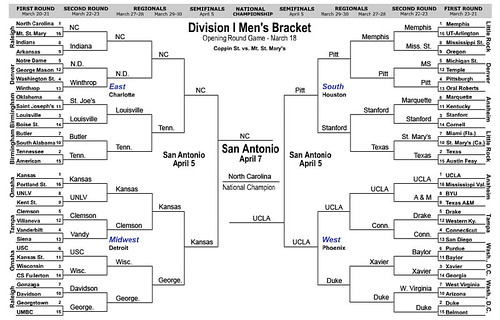
Anyway, it's not their fault the basketball has been dreadful. One out of four regional finals was interesting, and that one didn't go the right way (Kansas-Davidson). Sorry, but four number-one seeds in the Final Four isn't interesting. It might show that the best teams are there, but people don't watch the NCAA Tournament to see the best teams. They watch the NCAA Tournament to see that special Cinderella story. Cinderella isn't in San Antonio. Instead, the favorites are left, and it's not as much fun.

As for the championship game, Memphis and Kansas should provide an up-tempo affair. Both teams want to run, they have great athletes, and they can shoot the lights out. The game should be high scoring, and it should be the best game of the tournament. I like Memphis, because in my opinion, they'll have at least the two best players on the floor (Chris Douglas-Roberts and Derrick Rose ... Joey Dorsey has to fit in here somewhere, too).

(Since I said all of this, Kansas probably wins 63-44.)

Monday, February 25, 2008

THOUGHTS ON A LONG, BUT WONDERFUL DAY

I don't care how much you love hockey, or any other sport. 13 1/2 hours at one facility for one sport is a lot. That was my Saturday.

The most common question I got at the office today was completely unoriginal but totally expected and understandable.

Do you have any voice left?

It was unoriginal because I knew it was coming. I was hearing about it prior to Saturday. I knew I was going to be calling four hockey games on Saturday, and it wasn't really a secret to anyone. And knowing how worked up I can get during games, I had assumed I would lose my voice. I didn't, but I figured I would, and so did everyone else.

It was expected and understandable because, well, what else are you going to say?

Anyway, I had a few quick thoughts on games as I had time to type. But not only do I have time to type now, but I've had time to reflect on a whirlwind day.

Cloquet/Esko/Carlton vs Duluth East

When CEC got four in the second, I really thought it was over. Duluth East's top line of Jacob Boese, Max Tardy, and the vastly underrated Rob Johnson had done very little, thanks in large part to Cloquet's ability to pressure East's defensemen and slow down their breakouts. East looked frustrated, and out of sorts in a way. Yeah, Brent Olson got the rebound goal off a great play by Derek Forbort at the end of the second, but then the Lumberjacks got it right back on the delayed penalty goal in the final five seconds. At 4-2, East's goose looked cooked.

But that top line that was struggling through two periods hit another gear in the third. CEC couldn't match it. Johnson got one to cut the lead in half, and then he made a great rush down the left wing to set up Boese's rebound goal to tie the game. That line was responsible for the go-ahead goal, too, as Tardy jammed in a loose puck early in an East power play.

At that point, it was CEC's goose that looked cooked. They gave up three in a row, fell behind 5-4, and looked like they just couldn't slow that top line down. With East up a goal, Cloquet got a break. A turnover led to David Brown's third goal of the game, and the 'Jacks had tied it back up. After a controversial penalty call on East in the final seconds, Brown's fourth goal won it for CEC with :11.7 on the clock.

First off, both teams had calls go against them that led to goals. CEC's Justin Jokinen picked up a bogus interference call that turned into Tardy's power-play goal. The penalty on East's Boese that set up the game-winner was no more or less bogus, only more unfortunate in its timing. If East were searching for a culprit, they should look at two things:

1. The penalty kill. East allowed two power-play goals in two chances. Those power plays lasted 19 and 26 seconds, respectively. That just doesn't fly for me. Good work by CEC on the power play, but Mike Randolph just flat-out needed a bit more out of that penalty kill.

2. The second period. Ouch. Four goals, including a couple that came off sloppy work by East in their defensive zone. It left East with an uphill battle in the third, and while they did get the lead back, it turned out not to be enough in the end.

The other games

Sorry, none of them were nearly as good or as riveting. There was East/Cloquet, and there were the other three. It's a good thing in a way, because three more games like that one would have sent me for throat surgery.

Anoka blew past Grand Rapids 6-0 to earn a shot at Cloquet Thursday night. The Tornadoes controlled from start to finish, severely limiting the Thunderhawks' scoring chances and generating plenty of their own. Rapids had a great run, but this year wasn't meant to be.

The UMD women tossed aside St. Cloud State 5-1 and won the WCHA championship outright. There might be some off-ice issues right about now, but you wouldn't have known it by watching UMD Saturday. They looked focused, intense, and driven. The fact that the road to the NCAA title now goes through the DECC probably helps add to that focus.

For the UMD men, it was a tough night, as they suffered their second straight shutout loss. Richard Bachman of Colorado College was superb, and he deserves all the accolades. However, "two straight shutouts" is the kind of thing that will send fingers pointing right at a team's offense. It's not an offense that was going to score bunches of goals this year, but that's still a bit of a startling occurrence.

It's terribly unfortunate that there are UMD fans out there who are ready to shut down this team's chances. Perhaps UMD was outclassed by CC over the weekend, but the Bulldogs still played hard, outshot the Tigers, and showed at least some mettle by not quitting, unlike some teams who just can't stop the avalanche.

Listen. I'm not going to sugarcoat anything. It stunk. No one likes seeing the home team get swept. But we have to admit a few things.
  • CC is better than anyone we've seen at the DECC this season. They're also more than likely better than North Dakota, though UND's 13-game unbeaten streak has me re-thinking that one a bit.
  • UMD is still a good team. If the season ended now, they'd still make the NCAA Tournament. As much as the more fickle fan may want to poo-poo that as a "one and out" proposition, the guy who wears the big pads and the nicely-decorated helmet is going to have something to say about it. You get in the field of 16, bring a goaltender, and you have a shot at winning four straight.
  • The season isn't over. If the Bulldogs can manage to get some points out of this weekend's series with the Sioux, all will be forgiven. This is Minnesota, after all, and fans can turn faster than the Car of Tomorrow.
  • Let's be honest for a minute. No one who calls themselves a UMD fan would have turned down the chance to make the NCAA Tournament with a strong performance in the final few weeks of the season. The mere suggestion probably would have generated laughter among many of you in September.
Don't throw in the towel, UMD fans. I can promise you the players and coaches aren't.

Friday, October 26, 2007

BREAKING: NCAA AND NORTH DAKOTA SETTLE

This was bound to happen.

The NCAA and University of North Dakota have settled UND's lawsuit over a nickname ban (of sorts) enacted by the NCAA. The organization asserted that the use of "hostile and abusive" American Indian nicknames and mascots would prevent schools from hosting NCAA Tournament events, and the schools found in violation of the policy would not be allowed to use their logos or mascots at NCAA playoff events.

(That would mean the North Dakota hockey team, for example, could not wear jerseys saying "Sioux" and showing the Sioux logo during the NCAA Tournament.)

From the news article describing the settlement:

The agreement requires the school to win tribal approval for its Fighting Sioux nickname and logo within three years or retire it.

UND must win approval from the tribal councils of both the Standing Rock and Spirit Lake reservations.

If that approval is granted, it may be withdrawn at any time and UND must change its nickname within one year, said Attorney General Wayne Stenehjem.

According to the settlement, the NCAA also must post on its Web site a statement essentially withdrawing its claim that UND is hostile and abusive. Stenehjem said the agreement already has been signed by the NCAA.

If the logo is retired, some of the more permanent Native American imagery may remain on the Ralph Engelstad Arena. UND is suing the NCAA over its ban of American Indian nicknames and logos in postseason play. If UND can convince the state's Sioux tribes to support its nickname, the school could continue to use it in NCAA tournaments.

This settlement was bound to happen, given the fact that Judge Lawrence Jahnke was not willing to unseal documents in the case earlier this week. The news media had requested the unsealing, but one reason to keep documents sealed is because the sides are still discussing a settlement, and the release of the documents could jeopardize their ability to settle.

The settlement is a piece of good news, because now UND can go to work on convincing Sioux tribes in North Dakota that they want to have a relationship and not be recognized as hostile and abusive. The NCAA can work on governing college sports, which is their job, and get away from trying to be socially active.

For fans, it may not mean anything in the end. When October 2010 rolls around, hopefully UND has done the necessary work to keep a nickname that is steeped with tradition in North Dakota.

Thursday, September 27, 2007

MINDLESS SPECULATION: THE FUTURE OF COLLEGE HOCKEY AMERICA

Mindless Speculation will be a series that appears, well, when there's something to mindlessly speculate about. It will be what the name suggests. Nothing more. In most cases, it'll just be my guess as to how a story will play out, or if it will play out at all. When I can cite information, I will, only because it helps make me look like less of an idiot.

It's never a good thing to hear about the loss of a college sports program. Athletes need to make a decision: Find a new place to play my sport of choice, or quit playing that sport to stay where I am. Coaches lose jobs. Fans lose a team they have followed with dedication and passion.

In men's Division I hockey, it's really tough to lose a program. There are, after all, only 59 of them to start the 2007-2008 season. After this season, you can make it 58.

Wayne State (Mich.) has decided to do away with men's hockey after this season. The Warriors made the NCAA Tournament once, back in 2003, but never were able to build on that appearance. There was talk of building an on-campus rink, but it never happened. Instead, the Warriors played most of their games at the Michigan State Fairgrounds Coliseum, far from their campus. They never drew well, struggled to develop a loyal fanbase, and lost money as a result.

They tried to apply to the CCHA, in hopes of stabilizing the program, but they were denied. The feeling was that Wayne's future depended on getting into the CCHA.

Wayne State belongs to College Hockey America, a five-team league that has struggled since their inception. Originally six teams, CHA lost Findlay (Ohio) when they dropped the sport, and they lost Air Force to Atlantic Hockey. They were only able to add Robert Morris (Pennsylvania) to the fold in this time.

The league gets an automatic berth to the NCAA Tournament every year, but no team has ever won a game since the autobid was installed (Niagara had won as an at-large). Bemidji State, Wayne State, and Alabama-Huntsville have all put scares into higher-seeded opponents, but none were successful in winning a game.

When Air Force left, the NCAA gave an exemption to the CHA, allowing them to maintain their automatic bid, even though they didn't have the normal minimum of six teams needed for an autobid.

Now that Wayne State is leaving, the future of College Hockey America is in serious doubt. Can the NCAA continue to exempt a four-team league with programs that are largely struggling on the national scene? My guess is that the NCAA will remove that exemption at some point in the near future, leaving the CHA with four teams and no autobid, and virtually ending any chance the league has to survive.

As for its members, that's where things become hairy.

Robert Morris hasn't been around very long, so it's tough to tell what their future will be. Niagara has enough of a history that they should be able to squeeze into another league at some point, though Atlantic Hockey - the most sensible destination - claims they are staying put at ten teams. Alabama-Huntsville faces an uphill battle to keep their program alive, given their location far away from everyone.

Finally, Bemidji State is in a conundrum. The Beavers have tried to gain entry into the WCHA, but the league won't budge on its expansion moratorium. BSU has gone so far as to say their future as a program rests on entry into the WCHA. So far, that isn't happening.

All these facts aside, it's time to mindlessly speculate.
  • It's silly to count on expansion of Division I to help fill out leagues. We've heard about schools like Navy, Penn State, and Syracuse, among others, potentially having interest in Division I hockey. But those rumors need to go the way of Sid Hartman's Big Ten Conference theory (that is, away). I'll believe it when I see it, and for now, it's silly to count on this happening to help fill the ranks. We have to plan on making due with what we have.
  • Robert Morris and Niagara are a package deal. One has to hope that the RMU program doesn't fold almost as quickly as it started up. That would be horrible for college hockey. That said, from a location standpoint, these two aren't an ideal marriage. But it makes no sense to break them up, especially when the price is the likelihood of a league having to awkwardly schedule around an odd number of teams. These two will find a home together, I hope.
  • It makes geographic sense for Bemidji State to join the WCHA, but it won't happen by itself. Something else has to happen. Maybe UAH can jump into the CCHA while Nebraska-Omaha or someone else moves into the WCHA. The WCHA needs an even number of teams. No one wants to deal with an eleven-team league, which would create logistical nightmares for the schedule-makers and wreak havoc on the league's wonderfully-run postseason tournament (a huge money-maker for the league). Knowing only what we know now, I'll guess that Bemidji won't be joining the WCHA alone, if it ever happens at all.
  • All four programs are in some sort of trouble. I'm especially worried about Huntsville and Bemidji. I think something can happen for Robert Morris and Niagara out east, but Huntsville is on an island, and Bemidji is stuck in a spot where the only league that makes sense for them doesn't want them. Some might remember a day where UAH and BSU battled it out for the now-defunct Division II title. Since no one outside of Minnesota-Crookston plays Division II hockey in the Midwest, it doesn't appear viable for Bemidji to drop back. They can't drop back to Division III for hockey because it would require them to stop giving scholarships in their Division II sports (some of which are quite successful).
We can talk all we want about what the WCHA should do, or what the CCHA should do, but they both appear content with the teams they have right now. And it's not fair for these successful leagues to be criticized because they don't want to take on programs that might not be good competitive fits.

In the end, I think the odds are approaching 50/50 that Bemidji State will have to either move back to Division II, accept that they won't get into any major postseason tournaments, and try to get back in the Division III NCHA, accept being a Division I independent and dealing with the difficulties of scheduling and the lack of any automatic NCAA Tournament consideration, or drop the sport altogether. With the history Bemidji State has with hockey, the latter should be considered a last resort, and it would be one sad day for college hockey if it ever happened.

UAH faces a similar fate. They probably have to accept being an independent or drop hockey. It would not be a death-blow for the sport, but it certainly would seriously harm the chances of college hockey ever expanding to southern schools.

Right now, Atlantic Hockey says they're not expanding. However, I don't think that's the final word. Before it's over, I see the AHA at 12 teams. Either that, or they'll split up into two leagues of six, allowing the sport to maintain their six automatic NCAA bids and a 16-team national tournament. That's the ideal situation.

In the end, it's possible that Wayne State's decision is the start of a bad chain of events for college hockey. For now, it has to be said that this fate is preventable, but it's going to take a team effort.

Wednesday, August 29, 2007

RANDOMIZATION: 08/29/07

Football madness. I really am sorry to all of you who aren't into college and pro football. If you're a baseball fan, you can read the latest about that idiot managing the Brewers here. While you're there, stop and leave a comment - preferably a message of support to those who put that thing together. They deserve it, because they saw the writing on the wall before a lot of people did. And, yes, we did get Yosted again on Tuesday night. If you're a basketball fan, well go to True Hoop, because I just can't get into this FIBA thing, and nothing else is really happening in the NBA.

Hockey fans, hang tight. We're still about a month away. It's going to be fun.

College football gets started tomorrow night. Instead of being lame and trying to give you reasons why college football is better than NFL football, I've instead decided to try something different. You'll never see more than 16 NFL games in one weekend, even if you have the Sunday Ticket package. The following is a list of games I will be able to watch this Saturday alone, and it is without the benefit of a pay-per-view purchase.

East Carolina at Virginia Tech
UAB at Michigan State
Colorado State vs Colorado
Marshall at Miami (FL)
Appalachian State at Michigan
Northeastern at Northwestern
Youngstown State at Ohio State
Florida International at Penn State
Virginia at Wyoming
Arkansas-Pine Bluff at Mississippi Valley State
Southern vs. Florida A&M
Georgia Tech at Notre Dame
Wake Forest at Boston College
Washington State at Wisconsin
Missouri vs. Illinois
UCLA at Stanford
Iowa vs. Northern Illinois
Western Michigan at West Virginia
Arizona at BYU
Baylor at TCU
Oklahoma State at Georgia
North Texas at Oklahoma
Purdue at Toledo
Army vs Akron
Kansas State at Auburn
Tennessee at California
Indiana State at Indiana
Bowling Green at Minnesota
New Mexico at UTEP
Idaho at USC

30 games. No extra charge to me. This doesn't count any games I can find online. I know what I'll be doing Saturday.

Stupid NCAA rules. Brian Cook had this on FanHouse earlier today. The gist: An Oklahoma recruit was shot and killed a few days back. In order to help his family pay the $9,000 for the funeral, some OU fans started up a fund to raise money. The NCAA intervened and informed the fans that such a fund is a violation of NCAA rules, unless a waiver is requested by OU - and subsequently granted.

The stupidity of this knows no bounds. The sports world in general is wrought with image problems. Even fans occasionally do things that tarnish the overall image of sports fans. For once, someone is trying to make something good come out of a horrible story, and the NCAA intervenes to end the goodness.

I understand that they have rules. But why is a waiver required in order to raise money to help a family fund a funeral for a freaking murder victim?

UMD football opener. Last year, the Bulldogs may have actually had a better team, but they took a step back in terms of record and conference standing, going 6-4 overall and 4-4 in the North Central Conference. This season, UMD opens with a ridiculously tough three-game home slate, hosting three postseason teams from a year ago (Bemidji State, Missouri Western, and South Dakota). Leading the offense for a third year is starting quarterback Ted Schlafke. The junior didn't miss a start last year, but played hurt for much of the year.

The team ended the year on a high note, beating St. Cloud State to clinch a winning season, and in the process, UMD showed off the potential to run the ball more effectively than they had all season to that point. The Bulldogs, under head coach Bubba Schweigert and offensive coordinator Phil Longo, finally get to run the same system for a second straight year. The offense should look more fluid with all their returning experience. Even though star Greg Aker is gone, the passing game will click with Schlafke at the helm.

One key will be flashing a competent running game. The Bulldogs were often bad running the ball, which put more pressure on Schlafke to make plays with his arm, and it allowed defenses to key on the passing game. There's no doubt that today's brand of football doesn't require actual offensive balance, but a team that doesn't show it can run the ball is going to have a long day, much like how a team that doesn't show it can throw the ball is often going to struggle. It's not about 50/50 balance. It's about showing you're capable of 50/50 balance.

Defensively, UMD is loaded. Senior LBs Jon Rufledt, Nate Fears, and Cody Ahmann lead the way, but junior safeties Jim Johnson and Tyler Yelk also return. It's as experienced a defense as you're going to find anywhere in the NCC, and it might be the best defense UMD has fielded under Schweigert.

As I mentioned, the schedule is tough. The three postseason opponents to kick off the season are followed by a road trip to Central Washington, who is coming off a pretty successful NCC debut. The Bulldogs also travel to Nebraska-Omaha and have a home date with North Dakota in October.

This is the final year of North Central Conference football, and it looks like UMD will be right in the thick of the title picture when November comes.