Wednesday, July 09, 2008

COLLEGE FOOTBALL '08: BIG 12

Welcome to The Ciskie Blog's 2008 College Football Preview. As usual, you can expect a rundown of every Division I-A (or "Football Bowl Subdivision", if you prefer) conference, as well as a brief look at the independents. Some of the information used to compile these previews came from various football preview publications that I took the time to review this summer. I give a full endorsement to Phil Steele's College Football Preview (the national edition, as well as his various regional magazines). I also have looked at Sporting News, Athlon Sports, and Blue Ribbon (via ESPN Insider). Information was also gathered from local newspapers and school websites. Please use the comments section or e-mail for feedback, questions, and any corrections you feel need to be noted.

NORTH DIVISION
1. Missouri
2. Kansas
3. Nebraska
4. Colorado
5. Kansas State
6. Iowa State

SOUTH DIVISION
1. Oklahoma
2. Texas Tech
3. Texas
4. Oklahoma State
5. Texas A&M
6. Baylor

TOP FIVE STORYLINES IN BIG 12
More struggles at Baylor. Every school in the Big 12 has been to at least three bowl games since the calendar flipped to the year 2000. Well, every school except one has. Baylor has not seen the college football postseason since 1994. They've not won a bowl game since 1992. Guy Morriss was allowed five years to try to turn things around after being hired away from Kentucky, where he nursed the program through the worst of the Hal Mumme fallout. At Baylor, Morriss never won more than five games in a season, and he won just 18 games total. Even at a place that has become known as the Big 12's weakest sister, this isn't going to be accepted forever. Now, accomplished coach Art Briles takes over. He brings his funky spread-style offense from Houston, where he posted a so-so 34-28 record, but did guide the Cougars to four bowl bids in five years. Surely, Briles will be allowed more than a couple years at BU, and if he gets the resources he needs, the Bears should begin to improve as quickly as this year.

Is Kansas a flash in the pan? Last year's version of the Jayhawks did everything you could ask them to do, outside of beating Missouri. They rung up some serious point totals, including that 76-point outburst against Nebraska. Their defense was great throughout most of the year, holding opponents under 100 rush yards per game and keeping four teams from reaching double figures in points. They shocked many (evidently, we all thought KU would have "Just happy to be there" syndrome) by beating Virginia Tech in the Orange Bowl. So, can Mark Mangino engineer another magical season? They probably won't be 12-1 again, but they should be very good. Todd Reesing is back to run the offense at peak efficiency. RB Brandon McAnderson has to be replaced, but KU returns three starting linemen and two top receivers. The defense should be among the Big 12's best again. Nine starters are back, including the top four tacklers. Mangino's team has no fewer than six seniors starting on defense, and if Kendrick Harper can step up his game in departed CB Aqib Talib's spot, the Jayhawks won't miss a beat. 12-1 looks out of reach, but the Jayhawks only play four true road games all season long, and they bear watching once again.
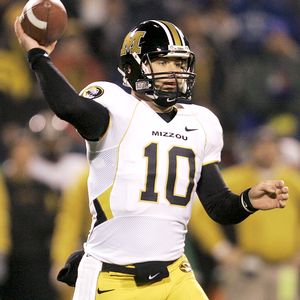
Chase-ing the H*i*m*n. Chase Daniel (right) returns to lead North Division champion Missouri's attack. He loses top receiver Martin Rucker and leading rusher Tony Temple, but freshman All-American Jeremy Maclin is back to catch passes and return kicks, and safety blanket Chase Coffman returns. Daniel threw for over 4,300 yards and 33 scores last year. He topped 300 yards in nine of 14 games. The Tigers might not win another division title, but they're favored, and the senior QB is a big reason why. Daniel is pretty much everyone's pick for the league's Offensive Player of the Year in the preseason. With Maclin, Coffman, and Tommy Saunders all back to catch the ball, and with a loaded offensive line, Daniel will put up some serious numbers again this year.

Oklahoma's defense looks to rebound. The Sooners were flat-out embarrassed in their Fiesta Bowl loss to West Virginia. Before that fateful night in Glendale, the OU run defense hadn't once yielded 200 yards to an opponent. Only Oklahoma State's 195 even came close, and that was in a 49-17 OU win. West Virginia ran for 349 yards and averaged 8.9 yards per carry in a 48-28 romp. The 349 yards exceeded the total Oklahoma allowed in their first five games (338). It was an awful way to end a superb season. The Sooners lose six starters from that defense, but they get back three starters on the line, while stud SS Nic Harris anchors the secondary. If Bob Stoops can find a replacement for departed feature back Allen Patrick, the offense won't miss a beat after averaging 42 points per game in 2007. Instead, the ultimate fate of this season rests on the defense. Can they rebound and play like a confident unit after the thrashing they got from WVU?
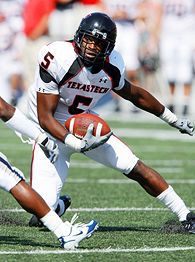
This is Texas Tech's time. For Mike Leach, it probably doesn't get any simpler than this season. He has a senior QB in Graham Harrell who is set to obliterate any remaining school passing records (he's less than 2,000 yards from Kliff Kingsbury's career mark, meaning he may set that before the Big 12 opener October 4). He has three solid dual-threat RBs to choose from, including sophomores Aaron Crawford and Baron Batch. WR Michael Crabtree (right) won the Biletnikoff Award as a freshman last year, catching 134 passes and falling 38 yards short of 2,000 for the season. Oh, and Leach's defense returns eight starters. The schedule shows tough road games against Kansas and Oklahoma, but the other really tough Big 12 games are in Lubbock, including Nebraska and Texas. If they're ever going to climb the mountain, it's going to be this season. The best part? No matter the record, there isn't a more entertaining team in all of college football.

BEST OF THE REST
Nebraska brings back Bo Pelini, this time for a longer head-coaching stint (he coached the team in the Alamo Bowl the year Frank Solich got fired). His first task is to rebuild the image of the Blackshirts defense, which gave up a rather ghastly 37 points and 477 yards per game last year. 80,000 people paid to watch the spring game, so you know they're excited in Lincoln. The coach's son looks to improve on a solid freshman season in Boulder. Cody Hawkins (right), son of Dan, leads the Colorado offense, which improved by leaps and bounds - and by nearly 100 yards per game - over a dismal 2006. Cody threw 17 picks in 13 starts, however, and that can't happen again. The Buffaloes upset Oklahoma a year ago, and with West Virginia, Florida State, Texas, and Oklahoma State all visiting Boulder this season, they may need to pull another upset or two to reach a bowl game for the second straight year. You think Ron Prince senses trouble at Kansas State? He brought in 19 JUCO kids in this year's class, hoping to supplement a roster that returns only 12 starters from a disappointing 2007. The Wildcats fell off badly, losing their last four games by a total of 86 points. The offense has to find a way to replace leading receiver Jordy Nelson and leading rusher James Johnson. Good luck. If anything positive can be taken out of the debut season for Gene Chizik at Iowa State, it's that they played some good football towards the end of the season. The Cyclones beat bowl-bound Colorado and also dealt a crippling blow to Kansas State's postseason hopes. Chizik gets 14 starters back and should field an improved team capable of winning four or five games. Texas lost an uncharacteristic three Big 12 games last year, but recovered to blow out Arizona State in the Holiday Bowl. The defense fell off terribly from when Chizik led the way, and now they have to replace seven starters this year. A favorable early-season schedule should get the Longhorns off to a fast start, but they don't appear to be strong enough to contend in the South. Mike Gundy made headlines for his anti-media rant last year, but the Oklahoma State coach made the right move in starting Zac Robinson ahead of Bobby Reid. The Cowboys are a secondary away from being a sleeper in the South, as Robinson will continue to lead the offense to serious numbers. Former Packers coach Mike Sherman takes over at Texas A&M. While I was no fan of his work in Green Bay, I think he will be fine in the college game. The problem will be trying to sort through the mess Dennis Franchione left him. While Sherman's smarts and play-calling acumen should serve him well with the offense, I'm not sure how the hell they're going to field a defense that doesn't get destroyed.

PRESEASON AWARDS AND NOTABLES
Offensive Player of the Year: Chase Daniel, QB, Missouri
Defensive Player of the Year: William Moore, S, Missouri
Coach of the Year: Mike Leach, Texas Tech
Coach on the Hot Seat: Ron Prince, Kansas State
Best Non-Conference Game: Illinois vs Missouri at St. Louis, August 30
Worst Non-Conference Game: SE Missouri at Missouri, September 6

Tuesday, July 08, 2008

IT'S TIME FOR BRETT FAVRE TO GO AWAY

Yes, that headline reads as crass, unemotional, and perhaps vindictive.

Sorry. Deal with it.

Let me start with a disclaimer. The jersey being modeled to the right is still in my closet. I still look at it with pride and nothing but positive memories. The career Brett Favre enjoyed in Green Bay is one to be admired and pursued for years to come. No one does what he did anymore.

Word that Favre is considering a comeback leaked last week. As expected, it's set the internet on fire.

It seems that the Packers are in no hurry to deal with this, as general manager Ted Thompson reportedly blew off a Favre text message during his vacation over the weekend. Naturally, this is a sin punishable by death in some circles. You don't blow off Brett Favre, sir. Not under any circumstances. Even if you are enjoying basically the only time off an NFL executive gets in a calendar year.

Whatever.

This charade has gone on long enough, and it hasn't even been a week. It's time for Brett to go away.

Favre had approximately 45 days to make up his mind about the 2008 season. He deliberated, discussed the decision with his family and head coach Mike McCarthy. On March 6, he tearfully announced his retirement. He cited fatigue, saying he'd given all he could give. He said he didn't think he wanted to play anymore. It sounded sincere, and it sounded like it was happening for the right reasons. After watching much of the question/answer session that followed his announcement, you had to come away thinking Favre was at a degree of peace over his decision.

The Packers sensed this, and they moved on. Aaron Rodgers was groomed through off-season workouts as the starting quarterback, and he appeared to get off to a good start with his coaches and teammates. McCarthy tweaked the offense to benefit Rodgers and his strengths, which are different than Favre's.

We find out now that Favre isn't at peace. Four months later, there are rumblings Favre wants the starting job back in Green Bay, or he wants to go play somewhere else.

Let's be realistic. The Packers aren't going to cut Brett Favre. He will not become a free agent. Ted Thompson isn't a dummy, and he'd be run out of town if Favre showed up as a member of the Vikings September 8, or for the Lions or Bears later in the season. No chance in hell.

However, can the Packers just welcome Favre back?

As much as it kills me, my answer is a quick and emphatic "No". Favre retired, then waited almost four months before indicating that he may have acted rashly. This isn't Dana Altman taking the coaching job at Arkansas before reconsidering and quickly returning to Creighton, or Billy Donovan going to the NBA before backing out and returning to Florida. Altman didn't change his mind months after making the move, and neither did Donovan. Those things happen.

Favre made a deliberate decision, gave the team no indication that he wasn't happy with his decision. His inaction and silence could be taken as nothing but an indication that the Packers needed to move on. They did. They trained his replacement.

For Favre to be handed his old job back now would be simply wrong. Life isn't fair, but it's about time the Packers did something fair for Aaron Rodgers. He's done nothing but be a professional about his awkward and difficult situation since the day he showed up. He's waited three years for his turn, and he's spent four months preparing diligently for his turn.

If the Packers intend to bring Favre back as their starting quarterback, without competition, then they need to trade Rodgers to a team that will give him a chance to start.

I don't think this will happen. I think the Packers will try their best to convince Favre to stay retired. If that fails, I see them either trading Favre or making him compete for the job with Rodgers. If the offense has truly been changed to favor Rodgers' game, it's not a lock Favre would win the job.

If they trade Favre, they control where he goes. They can tell agent James "Bus" Cook to seek a deal with a team that doesn't appear on the Packers' 2008 or 2009 schedules. They can make it clear to Cook and Favre that there won't be a deal done within the division.

While Favre has a ton of power here (simply sending a letter that requests his reinstatement would set wheels in motion for a lot of newsworthy events), but it shouldn't be forgotten that Thompson isn't a weakling, either. The Packers have the cap space to force Favre to ride the pine should they choose, and they have the power to trade him wherever they want (remembe,r there are no "no-trade" clauses in NFL contracts).

Packer fans will always appreciate Favre, but he's not handling this well. If he doesn't figure that out, it's inevitable that Favre's pristine legacy will face the risk of serious damage.

AN IDEA WHOSE TIME HAS COME

Matt Hayes of Sporting News did some interesting analysis on Big Ten football schedules. It got me thinking, so here we are.

Hayes looked at the non-conference schedules of the teams and rated them in order of strength. I have no issue with the rankings he drew up, nor do I have any issue with the content of his post or the idea behind it.

In fact, I applaud it. It really got my mind working on some stuff.

A grand total of two out of 11 teams in the Big Ten have non-conference schedules that don't include any Division I-AA (or Football Championship Subdivision, if you prefer) teams. Michigan State and Michigan are the only ones (kudos, by the way).

Three teams in the league (Wisconsin, Indiana, and Minnesota) don't meet a single foe from a BCS conference (ACC, Big East, Big 12, Pac 10, and SEC). Two teams (Northwestern and Iowa) don't face a single bowl team from a year ago.

In short, these schedules suck. Lots.

While my loyalty to the Big Ten is not without limits, I still didn't believe it would be fair to simply bash the Big Ten over this. The Big Ten is not the only guilty party. In fact, they aren't the worst offender.

Not even close.

Hayes broke down the other league's non-conference slates (check his archives for the info), and I consulted my Athlon's preview magazine for a quick gander.

There are 65 teams in the six BCS conferences. Of the 65, only 13 have a non-conference schedule void of any Division I-AA opponents this year. That's 20 percent.

Of the 42 BCS conference teams that play Division I-AA opponents this year, 11 of them won ten or more games last year.

By conference, the worst offender is clearly the ACC. The All-Cupcakes Conference has just one freaking team (Wake Forest) who didn't schedule a I-AA opponent. I hate to go all TMQ on you, but I hope the football gods reward Jim Grobe with another conference championship. Three bowl teams from a year ago (Clemson, Florida State, and Georgia Tech) saw fit to schedule TWO I-AA opponents this year (Clemson plays The Citadel and South Carolina State, Florida State hosts Western Carolina and Chattanooga, and Georgia Tech hosts Jacksonville State and Gardner-Webb).

You could justify Duke playing James Madison. It's Duke versus the Dukes. Imagine the shirts.

North Carolina and North Carolina State sucked last year, so it's not totally sinful for them to schedule McNeese State and William & Mary, respectively.

But why the hell is Boston College playing Rhode Island and Virginia Tech playing Furman?

All this lunacy has me thinking that it's time for an extreme move by the powers-that-be in college football.

It's time to make a rule that bans teams from BCS bowl consideration if they schedule more than two I-AA opponents over a rolling six-year period.

No one will be for it. The I-AA schools like the six-figure (possibly soon to be seven-figure) guarantees that come with these beatdowns (well, "beatdown" may not apply if you're Appalachian State). The BCS schools enjoy the guaranteed home sellouts and normally easy wins. Those wins help them move toward bowl eligibility, and they help the team gain confidence.

But it's a necessity. Think about it for a moment. If you match up open dates and weeks where I-AA opponents were used to fill the schedule, we're being robbed of some nice matchups. Among them:

Boston College-Rutgers
Kentucky-Kansas
Florida-Wisconsin
Georgia-Ohio State
Florida State-South Florida

That's just a few off a quick gander at schedules. You could draw up probably dozens of other great combinations.

Instead, we get crap.

Now, I know many of you will say "Hey! My team played so-and-so". And you'd be right. Ohio State does play USC. Clemson does play Alabama. Florida has Florida State and Miami on the docket.

Also valid would be the "My team only plays that I-AA team because someone else backed out of a contracted game on short notice".

That's why I went with the rolling two-year period. I don't deny that there are situations where a I-AA team is on a short list of options. It takes two teams to make a non-conference game happen. But we need to change the lazy, unimaginative, gutless mindset that has become epidemic in the game. We deserve better for our ticket money, and the fans who crowd around the TV sets for dozens of Saturday games every weekend deserve to see better matchups.

Monday, July 07, 2008

COLLEGE FOOTBALL '08: BIG EAST

Welcome to The Ciskie Blog's 2008 College Football Preview. As usual, you can expect a rundown of every Division I-A (or "Football Bowl Subdivision", if you prefer) conference, as well as a brief look at the independents. Some of the information used to compile these previews came from various football preview publications that I took the time to review this summer. I give a full endorsement to Phil Steele's College Football Preview (the national edition, as well as his various regional magazines). I also have looked at Sporting News, Athlon Sports, and Blue Ribbon (via ESPN Insider). Information was also gathered from local newspapers and school websites. Please use the comments section or e-mail for feedback, questions, and any corrections you feel need to be noted.

1. West Virginia
2. South Florida
3. Pittsburgh
4. Rutgers
5. Cincinnati
6. Louisville
7. Connecticut
8. Syracuse

TOP FIVE STORYLINES IN BIG EAST
The Hot Seat in Syracuse. Any coach who goes 7-28 in three years is going to find himself in some trouble. When that coach follows a guy who took the Orange to nine bowl games had just one losing season in 14 years, it spells nothing but trouble. At Syracuse, patience must be a virtue, because Greg Robinson got a fourth year. Despite the improbable upset of Louisville, the Orange weren't exactly improved in 2007. Their win total was sliced in half (from four to two), they were worse running the ball, they scored fewer points, and their defense was the worst it's been under Robinson. Considering Syracuse lost almost half their letterwinners (28 out of 65), Robinson better hope his recruits are good. They dominate the roster now, and they're going to be responsible for securing Robinson a fifth season.

Big D in Tampa. This is not to besmirch the South Florida offense, which should be improved thanks to QB Matt Grothe, a good running game led by Mike Ford, the return of seven of USF's top eight receivers, and an almost intact offensive line. But this might be the best defense in the Big East. All-American DE George Selvie is back, as are solid OLBs Brouce Mompremier and Tyrone McKenzie. Ben Moffitt is gone from the middle, but coach Jim Leavitt brought in a potential replacement in JUCO Kion Wilson. Senior S Carlton Williams leads the secondary. With a more balanced offense that probably won't make as many mistakes, the Bulls look to the defense for even slight improvement this year. If that happens, a run at the Big East title is far from being out of the question.

Life without Ray Rice. It may not be as hard at Rutgers as many anticipate. Sure, it's going to suck not having Rice, a 2000-yard rusher, around. But the Scarlet Knights have the makings of a potent offense in 2008. Triggerman Mike Teel has accomplished receivers in Tiquan Underwood (right) and Kenny Britt, who combined for 127 catches, over 2,300 yards, and 17 scores a year ago. If you want to blame their success on Rice's ability to keep defenses honest at the line of scrimmage, then you may want to know who will run the ball for Rutgers. The answer is uncertain. Sophomores Mason Robinson and Kordell Young appear to be the favorites. That said, Teel's experience and the super receivers he has to throw to should combine for a fine season in Piscataway.

Dave Wannstedt in a pivotal season. The seat might not be as hot as Robinson's, but it's getting there. Wannstedt has disappointed in his first two seasons at Pittsburgh, seasons that came after Pitt ran Walt Harris out of town for having the audacity to take the Panthers to the Fiesta Bowl. That loss to Utah is still the last bowl game this program has seen. Wannstedt is an incredibly average 16-19 in three seasons. The good news for him is that he has continued to recruit well, and this is probably the season he starts to reap the benefits of that recruiting. The Panthers lost just 13 letterwinners, and they return all their skill-position starters on offense. I really like sophomore RB LeSean McCoy, and his numbers should only increase this year as junior QB Bill Stull becomes more and more comfortable with the players around him. Wannstedt has a natural leader and incredible talent in senior MLB Scott McKillop, who had 91 more tackles (151) than any other Panther a year ago. With a relatively easy schedule to start the season, the Panthers should get off to a good start, something that may be enough to propel them to a bowl appearance.

Rich Rodriguez out, Bill Stewart in. After West Virginia's unreal performance in the Fiesta Bowl against Oklahoma, the administration didn't waste any time getting Stewart set up as the new head coach to replace Rodriguez. And why not? The players lobbied hard for Stewart publicly, and their performance in that game validated their lobbying. The offense isn't going to change a ton, continuing to emphasize the run. Pat White (right) will continue to star at QB, and Noel Devine will take over as the feature back for early NFL departure Steve Slaton. If Stewart can find a way to replace seven lost defensive starters, WVU won't miss a beat. The Mountaineers have the offensive tools and defensive talent to win this league again.

BEST OF THE REST
Look for Louisville to rebound from an awful season and at least get back in a bowl game. Steve Kragthorpe isn't incompetent, or he wouldn't have engineered the turnaround he did at Tulsa. QB Hunter Cantwell will make Cardinal fans move on from the Brian Brohm era quickly. Cincinnati's a prime contender to surprise in this league. Brian Kelly's offense is exceptionally tough to defend, and it may actually improve on the 36 points per game it scored a year ago. Connecticut surprised many last year with nine wins, and even though they have a ton of starters back, you can expect a bit of a fall. The Huskies were fortunate to win many of their games last year, and a schedule that includes road trips to Temple, Louisville, North Carolina, Rutgers, and South Florida doesn't look too forgiving.

PRESEASON AWARDS AND NOTABLES
Offensive Player of the Year: Pat White, QB, West Virginia
Defensive Player of the Year: George Selvie, DE, South Florida
Coach of the Year: Dave Wannstedt, Pittsburgh
Coach on the Hot Seat: Greg Robinson, Syracuse
Best Non-Conference Game: Kansas at South Florida, September 13
Worst Non-Conference Game: Tennessee Tech at Louisville, September 6

Sunday, July 06, 2008

REPORT: SABATHIA TO THE BREWERS

A doff of the cap to the Milwaukee Journal Sentinel's Tom Haudricourt, who has been all over the trade rumors in Milwaukee.

His latest update? It's a rumor no more. Now, it's a done deal, and the Brewers have added a significant chip in their quest for an end to their 26-year playoff drought.

C.C. Sabathia is headed to Milwaukee, pending all the formal paperwork and physicals and such.

I didn't start to follow the Brewers closely until 1985 or so, as the local media coverage in Duluth/Superior was pretty scarce. In 1987, the Brewers finally landed a local radio deal, which gave me the chance to do what a bunch of kids were already doing for Twins games. That, of course, was to have the little portable radio under the pillow so I could listen to games. Man, was it fun doing that!

23 years later, my team is finally a player on the trade market. They are a buyer. Or, more specifically in this case, they're a renter. Sabathia is a free agent after the season, and there's virtually no chance Milwaukee will pony up the $20 million per season it will cost to sign him. Instead, it appears the Brewers will load up on early picks in next June's draft, hoping to continue to keep stocked one of baseball's best farm systems.

Considering how many teams mortgage the future to make deals like this for rental players, the Brewers give up virtually nothing. Yes, Matt LaPorta is a top prospect, and rightfully so (dude can hit), but he's one of a load of All-Star minor-leaguers in the Brewers' system, and with (potentially) five of the top 35 picks next June, the Brewers aren't mortgaging the future. Not in the least.

Instead, they're using one of their great assets to take a shot at a pennant in 2008. Look at how strong the Brewers are at the top of their rotation (Sheets-Sabathia-Parra) and tell me this isn't realistic.

It absolutely is. And it's refreshing to see a general manager (Doug Melvin) and an owner (Mark Attanasio) who are willing to go for it.

The Brewers won big today, taking the lead in the National League Wild Card race. Ryan Braun was announced as a starter for the NL All-Star team. And C.C. Sabathia is becoming a Brewer, even if only for a few months.

Bad things aren't the only things that happen in threes.

VOTE FOR COREY

Please click the "Vote at MLB.com" link to vote for Corey Hart. He's up against the mighty David Wright, among others, for the final spot on the National League All-Star team.

COLLEGE FOOTBALL '08: ATLANTIC COAST

Welcome to The Ciskie Blog's 2008 College Football Preview. As usual, you can expect a rundown of every Division I-A (or "Football Bowl Subdivision", if you prefer) conference, as well as a brief look at the independents. Some of the information used to compile these previews came from various football preview publications that I took the time to review this summer. I give a full endorsement to Phil Steele's College Football Preview (the national edition, as well as his various regional magazines). I also have looked at Sporting News, Athlon Sports, and Blue Ribbon (via ESPN Insider). Information was also gathered from local newspapers and school websites. Please use the comments section or e-mail for feedback, questions, and any corrections you feel need to be noted.

ATLANTIC DIVISION
1. Clemson
2. Wake Forest
3. Florida State
4. Boston College
5. Maryland
6. North Carolina State

COASTAL DIVISION
1. Virginia Tech
2. Miami (FL)
3. North Carolina
4. Georgia Tech
5. Virginia
6. Duke

TOP FIVE STORYLINES IN THE ACC
David Cutcliffe. Cutcliffe is a rare find for a Duke program that has gone with unproven head coaching commodities such as Barry Wilson, Fred Goldsmith, Carl Franks, and Ted Roof since Steve Spurrier walked out the door in 1989. Only Goldsmith has taken this team to the postseason, and that was apparently a colossal fluke. Cutcliffe, who did many, many good things as head coach at Mississippi, gives Duke something they haven't had in years: A chance. He won't turn it around this year, but with Eron Riley and Thaddeus Lewis (assuming he is reinstated) to lead the offense, he has tools to work with. The Blue Devils need to field a more competitive defense this season, and co-coordinators Mike MacIntyre and Marion Hobby both have NFL experience. They also have ten starters back from last year's dreadful unit.

Resurgence in the Carolinas? While neither Butch Davis nor Tom O'Brien took their respective teams to a bowl game last year, teams at North Carolina and North Carolina State should be improved again this season. Showing how bare the cupboard at UNC was, Davis chose to play an astounding number of underclassmen, including a bunch of his own recruits from the 2007 class. As SMQB notes, it was a bold move that bodes well for the future. The Heels have a sophomore QB in Tyler Yates who played well last year, but also played like a freshman a lot of the time (18 picks). Sophomores Greg Little and Ryan Houston will improve a running game that only topped 150 yards in a game twice (Miami and Duke). At NC State, O'Brien appears to have set his program up for the long haul, playing the upperclassmen last year and then watching 25 of 53 letterwinners depart. If senior QB Daniel Evans can play the way O'Brien and Chuck Amato both thought he would, the Wolfpack might have a chance to crack the bowl lineup this year.

Randy Shannon leading Miami back. After last year's Orange Bowl-closing 48-0 loss to Virginia, it became clear the Hurricanes weren't going to sink much farther. Losses on the road to Virginia Tech and Boston College cemented the first non-bowl season for Miami since 1997. It isn't likely to happen again this year, as the Hurricanes have loaded up on young talent, and also found a young QB who should excel. Kyle Wright never established himself as a star, and he leaves to make room for Robert Marve, a redshirt freshman. The running game will be stellar, the offensive line should show great improvement, and Shannon has a boatload of seniors projected to start on defense. If Miami survives early-season trips to Florida and Texas A&M without losing confidence, Shannon will take them back to the postseason.

Clemson is a contender. Tommy Bowden has a loaded roaster. Cullen Harper developed nicely as the starting QB. James Davis and C.J. Spiller return in the backfield. Eight starters, including hulking DTs Dorell Scott and Rashaad Jackson, return. Expectations are high, and the early-season schedule is favorable. After a neutral-site game against Alabama, the Tigers host The Citadel, NC State, South Carolina State, and Maryland in back-to-back weeks. The October 9 date with Wake Forest looms huge for both teams, as well as the Atlantic Division title.

The turmoil at Florida State. As many as six starters will miss games in the early part of the season, the result of suspensions for academic problems that erupted last year and affected FSU's roster for the bowl game against Kentucky. Bobby Bowden coaches his 33rd season at FSU this year, but offensive coordinator Jimbo Fisher has been installed as the "head coach in waiting". Fisher's impact on the team last year wasn't as great as many thought it would be, as the Seminoles enjoyed only marginal increases in their yardage totals, and actually scored fewer points per game than the previous season. With an experienced QB, experienced RB, and solid senior receiver in Greg Carr, Fisher needs to get more out of his skill players this season.

BEST OF THE REST
Wake Forest should be primed to make some big-time noise this year, thanks to smart coaches, a two-year starting QB in Riley Skinner (right), oodles of talent in the offensive backfield, and nine starters on defense. Maryland head coach Ralph Friedgen gave up the play-calling duties, and hopes new coordinator James Franklin can jump-start a unit that struggled to run the ball the last four years. It's likely that Boston College lost too much talent to be a serious contender this season, though they should be a solid postseason contender. A quarterback rotation was the key to Virginia Tech's season last year, and the Hokies hope it can help them follow up on last year's 11 wins. Only four starters return on defense, including star cornerback Victor "Macho" Harris. Duke isn't the only program to make a solid coaching hire, as Georgia Tech brought Paul Johnson in from Navy. Johnson is an extremely intelligent coach who will bring results to Tech, but probably not right away because of the necessary transition to a new offense. Struggles could be all over the place at Virginia this year. Chris Long carried the defense, and there are still a ton of questions on offense.

PRESEASON AWARDS AND NOTABLES
Offensive Player of the Year: James Davis, RB, Clemson
Defensive Player of the Year: Alphonso Smith, CB, Wake Forest
Coach of the Year: Randy Shannon, Miami
Coach on the Hot Seat: Ralph Friedgen, Maryland
Best Non-Conference Game: Virginia Tech at Nebraska, September 27
Worst Non-Conference Game: Western Carolina/Chattanooga at Florida State, September 6 and 13

Saturday, July 05, 2008

BREWERS LOOKING AT SABATHIA

A couple weeks ago, ESPN's Buster Olney told the Baseball Tonight audience that the Milwaukee Brewers would be a contender to trade for Cleveland left-hander and reigning AL Cy Young winner C.C. Sabathia.

I laughed. My wife looked at me, and I said "No way we trade for a guy who we can't sign".

In my heart of hearts, I thought I was right. However, this is where I can sometimes get burned for spending no time whatsoever following the Brewers' minor-league system.

See, the Brewers' Double-A team in Huntsville is very good. So good that they had eight guys picked for the Southern League All-Star Game. And with that information as a backdrop, you can understand why Milwaukee appears to be taking their best shot at Sabathia.

Tom Haudricourt lays out the rest of the case, beyond the superb minor-league system.
The Brewers lost young right-hander Yovani Gallardo for the season with a knee injury on May 1, a devastating blow to their starting rotation. With right-hander Ben Sheets headed for free agency after the season and the future of first baseman Prince Fielder uncertain, the Brewers aren't guaranteed of being in this position a year from now. That situation heightened the urgency to find an established starting pitcher who might put them over the top, and they immediately targeted Sabathia.
Meanwhile, Buster Olney of ESPN.com explains why you make this deal, citing the Brewers' outstanding scouting and player development system.
The Brewers are a mid-market team that must rely on its player development to compete, so trading a star prospect like LaPorta would be a major sacrifice. However, rival officials note that the Brewers have an excellent track record in scouting and drafting and got a boatload of picks in the recent June draft. And if Milwaukee were to deal for Sabathia and then see him walk away as a free agent at year's end, along with Sheets, the Brewers likely would receive four compensation draft picks. "You might see them have five picks among the first 35 in the draft," said an NL official.
Wait. You mean we can take a shot at the World Series with two dominant starters, then give universally respected scouting director Jack Zduriencik five of the first 35 picks in next June's draft?

I'm sold. Let's go for it.

It's been 26 years for the Brewers. With Ben Sheets likely set to walk after the season, there's no harm in adding another pitcher who will also walk. Let Manny Parra, Jeff Suppan, and (gulp) Dave Bush or Seth McClung finish off the rotation. Besides Parra, the only pitcher in need of developmental time at the big-league level is Yovani Gallardo, and he looked very good before he was injured and lost for the season a month in. So you're not costing yourself any time that could be spent developing other players. Let Sheets and Sabathia anchor the starting rotation, and carry us as far as we can go.

Maybe, if we get this pitching staff to a certain level, it will be impossible for Ned Yost to screw it up.

Wednesday, July 02, 2008

ASS-ININE

One of the great sports cities in America has just lost its long-standing NBA franchise.

Noted snake Clay Bennett cut a deal with the City of Seattle that allows him to move the Sonics franchise to Oklahoma City this year. Originally, the city had sued Bennett to force him to play out his Key Arena lease, which was set to expire after the 2009-2010 season.

NBA commissioner David Stern (above, right) has done nothing to help preserve the sport in Seattle, which has hosted a professional basketball franchise for 40 years. And why would he? The league is somehow convinced that Oklahoma City, which has exactly zero major-league pro sports franchises, can adequately and consistently support an NBA franchise.

Hey, what a great idea!

While we check out this new market and see if it will actually work, let's screw over a traditionally strong sports town. Bennett and the NBA have now gotten just enough cooperation from the city in order to do that.

The settlement calls for a meager $45 million payment from Bennett, with $30 million more due if Seattle doesn't secure a new team by 2013 (and Stern offers no guarantees that will ever happen). I'm stunned that the city would cave like this, basically allowing Bennett to buy himself out of town for $45 million, and allowing Stern to guarantee NOTHING from the NBA.

(Stern's "Bow down and kiss our feet, suck our toes, and lick our calves, and we may think about looking into talking about getting you a team in the future" statement is the ultimate in bogus garbage from sports commissioners. He promised nothing but a discussion, and that's only if the city and State of Washington pony up and pay for a new playground first. Of course, that new playground could ultimately sit empty for perpetuity, but at least Stern will think about it. That's worth $300 million, right?)

It's a jackass deal from a jackass league that is run by a jackass.

FAVRE TALKING RETURN FOR 2008

Well, that was quick.

ESPN's Chris Mortensen reports that former Packers QB Brett Favre may not be a "former" Packers quarterback for much longer.

Mort says Favre has contacted Packers head coach Mike McCarthy to express an interest in playing this season.
Favre has communicated his potential desire to coach Mike McCarthy but talks have not advanced to a substantive stage, a Packers source said. ...Another source conceded Favre was "getting the itch" to play football in 2008. However, Favre's agent downplayed the likelihood that the quarterback could un-retire or that he was prepared to report to camp July 28. "As far as I know, right now, Brett Favre is retired and until he tells me something different, that's what it is," James "Bus" Cook, Favre's agent, said.
Evidently, Favre has the "itch". He's not the first athlete, and he won't be the last.

What should the Packers do? The answer is obvious.

Aaron Rodgers is the starting quarterback. Move on.

And, yes, I'm serious. Aaron Rodgers is the starting quarterback. Entertain trade talk for Favre if he's serious, and open the bidding only to AFC West and AFC East teams.

(Why those two divisions? Because it will be at least 2010 before the Packers play the AFC East again in the regular season, and 2011 before they see the AFC West, assuming the current rotation continues. They play the AFC South this year, and draw the AFC North next year.)

(Thanks, FanHouse and Milwaukee Journal Sentinel!)