Wednesday, June 15, 2011

Tim Pawlenty Trips On Own Rhetoric

Sunday, former Minnesota Governor Tim Pawlenty, now running for President, appeared on the always-friendly Fox News Sunday to rip fellow Republican candidate Mitt Romney.

Well, I'm sure he was there to rip the current President, because that's how Fox News Sunday rolls, but it turned into an opportunity to rip Romney. Since they're rivals for the right to lose the election earn the Republican nomination next year, Pawlenty couldn't turn down a chance to take a shot at Romney's health care plan when he was governor of Massachusetts.

Then the two appeared together for a Republican debate on CNN. Hilarity ensued, as Pawlenty tried to explain his shot. He didn't do well.

Enjoy Jon Stewart breaking down the debate.


This is why you have to be careful with your rhetoric. You can hear Pawlenty backpedaling while trying to tap-dance at the same time, and he's lucky he didn't fall and hit his head. That might have required care from a doctor.

Monday, June 13, 2011

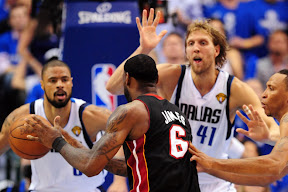
LeBron James Still Doesn't Get It

And you wanted it all
Now you’re taking the fall
You don’t know why

--Red Line Chemistry, "You Don't Get It"

I'm not a huge NBA fan. Probably never will be, though it would be greatly helpful if the league put in a system that made it possible for more than about five teams to win a championship.

But if someone tells me that Miami is trailing throughout in their bid to stay alive in a series, and the Dallas Mavericks -- owned by Mark Cuban and led by the exceptionally likable Dirk Nowitzki -- are the opponent, I'll flip it on and watch.

No one outside of Heat fans wanted to see Miami win this championship. Their fans are insufferable bandwagon-jumpers, many of whom probably couldn't name three guys from the 2006 championship team. The team is led by Dwyane Wade, one of my favorite players, but no one gives him the credit he deserves for being the alpha dog. Instead, everyone wants to know why LeBron James isn't the alpha dog.

Well, folks, for starters, he's not the best player on the team. Wade is. Shouldn't the best player be the guy you run the offense through, instead of the second-best player?

James is a fantastic talent, but he typecast himself as a secondary piece the second he decided to "take (his) talents to South Beach."

That moment ended any opportunity for James to ever be considered one of the sport's all-time great players. He decided to ride Wade's coattails, instead of being a leader of his own team.

Mind you, that's okay. It's not the end of the world that someone doesn't want to be the greatest of all-time. Most of us are okay with our roles. We don't need to be the president of the company we work for, and we don't need a fancy title in front of our name to feel important. It doesn't make it a good or bad thing to want or not want those things. It's just the way we're wired.

In the case of LeBron James, he's not wired to be the best of all time. Wade? Well, he kind of is, and that's why he is the leader of the Miami Heat.

After Game 6 Sunday night, James showed the world that he isn't just a guy not wired the way Michael Jordan and Kobe Bryant are. He's also a very bitter and immature fellow who just doesn't get it.

“All the people that were rooting for me to fail… at the end of the day, tomorrow they have to wake up and have the same life that (they had) before they woke up today,” James said. “They got the same personal problems they had today. And I’m going to continue to live the way I want to live and continue to do the things I want to do.”

Just remember, LeBron haters, that your life sucks compared to LeBron. Just ask LeBron, and he'll tell you.

It's the typical arrogance of a man who thought it was a good idea to knife an entire fanbase in the back on national television, and didn't bother to tell the franchise he was leaving of his intentions before said knifing.

In the world of public relations disasters, "The Decision" will live on forever. Sunday's interview will be high on the list for LeBron, because he showed again how insanely immature he is, and how far he has to go before he can ever be considered in the class of a guy like Nowitzki.

Meanwhile, as Dan Wetzel writes, Cleveland isn't hating anymore.

They're just laughing.

So are the rest of us, especially Mark Cuban.

Thursday, June 09, 2011

The Teardown of Ohio State Continues

It's been over a week since Ohio State finally had the good enough sense to tell Jim Tressel to get the hell out of town. The leader of the nation's most self-absorbed and sanctimonious football program was exposed as a fraud on the level of Lane Kiffin, only a fraud who won at least ten games virtually every year he was on the job.

In other words, Tressel was a cheater who actually knew how to take advantage of his cheating. Kiffin is just a fool until proven otherwise.

While the NCAA continues its investigation, and the Buckeyes try to find a quarterback, along with the soul they sold to win BCS games, it's interesting to read different takes on the situation.

Bill Carter of Sports Business Journal doesn't even want to call Tressel a coach, that's how low he thinks of the former media favorite.

He also tears down the notion that coaches who run opposite of Tressel should be considered heroic, or that they should be cheered incessantly for making tough decisions. As an example, he notes that Virginia lacrosse coach Dom Starsia led his team to a national championship this season, even though one of his players was charged with murdering a women's player last year, and he has dealt with disciplinary issues during this season.

This is no slight on Coach Starsia. I think he did a commendable job in which he should be congratulated — just not honored. A year ago, he provided leadership to a group of young men between the ages of 18 and 22 as they tried to understand a tragedy for which they had no experience to draw from. This year, University of Virginia lacrosse coach Dom Starsia provided the appropriate leadership expected of any college coach. Ohio State University football coach Jim Tressel did not. This year, he punished individuals with no consideration of their skill level, for behavior that was detrimental to the team.

I’ll say it again — he did what we should expect any adult in a leadership role to do. Nothing more. I hope the athletic director and the administrators at the University of Virginia reward Coach Starsia with a handshake and a smile and tell him “good job” — which would be commensurate with the job he has done. But, by no fault of his, I’m sure he will be lauded as a hero for making “tough decisions” (I would simply call them “right decisions”).

I guess you would call Coach Starsia heroic if you are comparing him with Jim Tressel. (I can’t even call Tressel “Coach”.) Tressel provided no leadership whatsoever. Himself overpaid and self-entitled, he allowed the teens and young adults for which he was responsible to behave similarly (despite the fact that being paid at all is breaking the rules and to be self-entitled will result in difficulties out in the real world — so much for college football coaches teaching life lessons!).

I could write 100 paragraphs on how disgusting I think his behavior is, but it’s a bore. To me, Tressel is a nobody. He’s a footnote. I hope I forget about him by the end of this week, though I doubt ESPN will let me. 

The ESPN part is funny, because as one-time FanHouse comrade Clay Travis noted weeks ago, ESPN was flat-out refusing to cover this story was it was breaking in front of the world. Naturally, they weren't covering it because they wanted to both protect Tressel and themselves ... they didn't break the story, so they weren't going to take it seriously.

No one can deny the hero worship we give to coaches like Starsia, provided it's in a sport we care about. The problem is that we also mix in hero worship for cheats and liars like Tressel, and then we just brush them off like yesterday's news when they're exposed.

After all, there are other cheats and liars to worship. Until they get exposed, too.

The Essence of Ryan Kesler

Ryan Kesler is a 40-goal scorer, two-way player, faceoff force, overall superb talent, and also one of the chippiest players in the sport of hockey.

Never has the last part of that been more true than the final moments in Game 4 of the Stanley Cup Finals Wednesday night in Boston.

Given a chance to face Bruins captain Zdeno Chara man-to-man after teammate Alex Burrows started more crap with goalie Tim Thomas, Kesler backed behind a referee and then took a poke at the biggest bear.


Real gutsy, Ryan, to hide behind a referee. Just because the Sedins like to do it doesn't mean you should follow the lead.

What do they say about poking the bear? Seems the Canucks haven't figured that out yet.

Wednesday, June 08, 2011

USA Hockey Proposal Hits a Nerve

Saturday, USA Hockey will vote on a proposal to ban checking at the peewee level of youth hockey. That means kids playing under the USA Hockey banner will not be allowed to throw body checks until they are 13 years old, when they are bantams.

Your first reaction to this proposal is probably close to mine, which was "This is stupid," "We can't keep shielding kids from the physical part of the game if they're ever going to learn it," or "Ugh."

But that's why you don't base a public stance on the first thing you think of in reaction to an idea like this. Sometimes, you have to read more about it.

(You don't always have to. When some guy proposed getting rid of any government service you can get online -- presumably said "some guy" wants to get rid of elections, since people can easily vote for things online -- you can react immediately to that insanity.)

With that in mind, here is some reading material on USA Hockey's proposal.

Manual
FAQ
Webinar

Here is a video discussing the potential changes.


I encourage you to read all of this and draw your own conclusion. It's clear through my conversations with hockey people that this idea has hit a bit of a nerve, even with those in favor of the idea.

Here are some points made by USA Hockey in the online FAQ linked above.

... cognitively, the 11 year old brain has not fully developed the ability to anticipate while multitasking. Anticipation is 50% of a player’s ability to protect himself and avoid heavy contact that leads to these serious injuries. We realize there should be contact in hockey; however, we do not want to place players into a situation where their cognitive skills are not yet fully developed to protect themselves. This is a function of brain development that players cannot “learn” by doing.


******

Body contact and body positioning skills are far more important for a player to acquire at the Pee Wee level and are the precursors to effective checking and playing skills as they get older.


******


It is not accurate to simply say USA Hockey is taking checking out of Pee Wees. The overall proposal is to increase the allowable body contact beginning at Mites and progress through Bantam when full, legal body checking would begin in games. As an example, the American Developmental Model (ADM) Red, White & Blue Hockey at 8U introduces the cross-ice environment to increase traffic and congestion and thus the associated natural body contact by simply reducing space.

The proposal would then increase the allowable body contact as players progress through Squirts and Pee Wees. Competing at the puck, angling to gain possession or stopping an offensive attack are examples at these levels. An important objective of thisproposal is to eliminate the “Big Hit” in Pee Wees where players ignore the puck and try to ‘blow up’ an opponent.

Though not allowed in games, coaches will be asked to introduce and teach full body checking techniques in every practice (~85 practices / year = ~170 total during the two years) during the two Pee Wee years. We believe this to be a better solution than what we often times see today as a single weekend “introduction to checking” clinic. The proposal is to provide players with two years to acquire the necessary checking skills in a safer environment.

There are a few big points for me. For starters, hockey associations really need to go "all-in" on the American Development Model for this to be a successful transition. As USA Hockey says, they aren't trying to take body contact out of the peewee level. And if you watch the video, there is a stark difference between body checking (no attempt to play the puck) and body contact (oftentimes done as a means to protect the puck from an opponent).

That said, it's going to be hugely important for local associations to emphasize the teaching points brought out in the ADM and mentioned in the proposal. USA Hockey doesn't want coaches to de-emphasize the teaching of proper body checking and body contact in practices. It's just as important as teaching systems or other hockey skills. Instead, coaches need to make sure they provide squirts and peewees with a base of knowledge for how to properly check, and how to do successfully backcheck or win a battle for the puck on the wall without throwing that big, intimidating hit that USA Hockey is trying to de-emphasize.

None of it works without cooperation at the lower level, and not just with certain portions of the ADM. You can't decide to play half-ice games with 8U teams half the time. It's all or nothing, or the kids just aren't going to get out of half-ice games what USA Hockey wants them to. Same goes for the suggested number of practices. Coaches need to work to get their kids the practice time necessary to learn how to play the game the right way. Following the ADM isn't exactly a bad idea in this regard.

In the end, this proposal -- which is expected to pass -- isn't getting a full endorsement from USA Hockey's membership.

In a close vote, (Minnesota Hockey) instructed its four representatives on the national board to vote against raising the age level for legalized checking from peewees (ages 11 and 12) to bantams (13 and 14).

Among Minnesota Hockey's concerns about banning peewee checking are:

• Girls would stay in boys' hockey two more years, hurting the overall development of the girls' game.

• Non-USA sanctioned programs will continue to check.

• There is insufficient time for players, coaches, officials and parents to adapt.

• Peewee coaches might not teach checking in practices, which would increase injuries among bantam players.

No one thinks this is some sort of world-ending idea, but there are some who think tougher penalties on illegal checking would do more to educate kids than this proposal will.

But in the end, I'm a believer in the idea that if coaches do what USA Hockey wants them to do, things will work out fine. Kids will learn to check the right way, and while it won't take injuries completely out of the game (nothing will do that), this proposal will make the game safer for kids under 13. Hopefully, it's a tool that can be used to keep more kids playing the game as they get older and their bodies round into form.

NHL Paved Way for Dirty Canucks to Win

In 2007, the Anaheim Ducks punched, kicked, stomped, elbowed, obstructed, and won the Stanley Cup.

Don't get me wrong. That was a very talented team, led by guys like Teemu Selanne, Scott Niedermayer, and Chris Pronger, and backstopped by the duo of J.S. Giguere and Ilya Bryzgalov. They could play with anyone.

They were also the dirtiest team in hockey.


They won anyway, because the NHL has a long-standing habit of "letting the players decide the outcome of the game" by not calling anything they don't have to call.

When you do go a man down, you can pretty much do whatever you want, provided you don't get caught with too many men on the ice, or shoot a puck over the glass from your defensive zone.

(How stupid is that, by the way? You can practically behead players while short-handed, but don't you dare put the puck over the glass. It's akin to NFL officials letting players get away with late hits whenever they want, but not missing any false start calls. That, by the way, doesn't happen, because officials in other sports actually call infractions in the playoffs.)

This type of mentality -- an obvious league-wide issue -- has paved the way for teams like the 2007 Ducks, 2010 Philadelphia Flyers, and 2011 Canucks to succeed. All you need are a few officiating bounces, and you can win games in the Stanley Cup Playoffs.

Last year, it was the Flyers benefiting from officials turning the other cheek. Never mind that Pronger is a shell of his 2007 self in virtually every way except his ability to be a dirty player. He doesn't skate like he used to, and he's not as sharp a player as he was when he was in his prime. It's called "getting old," and we all do it. Now, instead of using his size to shield players and win physical battles, he uses his size to interfere and obstruct, and since he's Chris Pronger, he gets away with it.

The Canucks certainly have talent, just like the Flyers did last year. The Sedin twins, Ryan Kesler, Mason Raymond (former Bulldog!), Alex Burrows, Manny Malhotra (welcome back), Christian Ehrhoff, Kevin Bieksa, Roberto Luongo, and others certainly have the skill and will to win the Stanley Cup.

Of course, the good is overshadowed by the bad, especially in the cases of Kesler and Burrows. Throw in guys like Raffi Torres and Maxim Lapierre, who have skill but are about as honorable on the ice as a December day in Fairbanks is long, and you have a group that should be killing a lot more penalties than they are.

Instead, you have officials looking the other way while the Canucks cross-check and hold their way through a five-minute major penalty kill, and you have Lapierre diving all over the place while Torres throws a flying elbow that goes undetected by anyone because he was unlucky enough to miss on the attempt. To make matters worse, captain Henrik Sedin and brother Daniel have both been guilty of embarrassing embellishments during this series.

It's infuriating, really, because guys like Raymond, Malhotra, Luongo, and Ehrhoff are talented, skilled, and honest players who just don't pull this crap, and they shouldn't have to be associated with a bunch of guys who do.

Alas, that is how you win, though. It's not necessarily about who the best or most talented team is.

(Though there is no denying that Vancouver is hella talented and very deep at all positions. Very impressive.)

It's about what team is willing to push the envelope and try to get away with more BS. More often than not, teams will get away with said BS, and they'll win as a result.

This is a message you can expect the rest of the NHL to begin receiving. It's a copycat world, after all.

Monday, June 06, 2011

Richard Childress Tries, Can't Convert Kyle Busch Into Sympathetic Figure

Let's recap these events.

Kyle Busch is notorious among drivers and fans for a hot temper on the track, but also has a reputation for being one of the most charitable men in his sport ... almost always willing to help out other drivers' causes, as well as his own. Despite that work off the track, Busch is far and away the most disliked driver in the sport. It's not even really close.

Richard Childress, a 65-year-old man who owns vehicles in NASCAR's major touring series, is perhaps best-known as the man who was Dale Earnhardt's friend and car owner and now owns cars driven by the likes of Kevin Harvick and Clint Bowyer. He's also one of the most respected figures in NASCAR.

So when worlds collide, and Childress is the one allegedly instigating a physical altercation with Busch, what's a guy to think?

After Saturday's Camping World Truck Series race at Kansas, it was indeed Childress going all Nolan Ryan on Busch, who unwittingly was set to play the role of Robin Ventura.


We can't confirm that things went down the same way Saturday. In fact, it seems it was Childress who did all the work.

According to reports, the 65-year-old Childress approached the 26-year-old Busch in the garage area after the race, took off his watch, punched Busch in the face and then put him in a headlock.

NASCAR did their part to make it clear that Busch, who is on probation after trying to kill Kevin Harvick (possible exaggeration), did nothing wrong Saturday.

"We concluded that the driver of the 18 truck, Kyle Busch, did nothing to provoke or to cause the reactions, that in our opinion, would violate the probation," Helton said. "He did nothing that warranted the actions of Richard Childress."

Again ... Kyle Busch did nothing wrong. Nothing. Notta. He was the race-car-driver-gets-punched-in-the-face-by-old-man equivalent of an innocent bystander.

And yet people tweet stuff like this.


Oh, wait. That's me.

You get the point.

Busch is not the sympathetic figure here, even though NASCAR wants you to know he was attacked.

By a 65-year-old man.

And Childress knew what he was doing. This wasn't a heat of the moment thing, or he wouldn't have thought to take his watch off.

Yet Busch is still a jerk in the eyes of most NASCAR fans. If this can't cure it, nothing will.

Thursday, June 02, 2011

Alex Burrows, Henrik Sedin Embarrass the Game

Game 1 of the Stanley Cup Finals was a lot of fun to watch, as Vancouver and Boston slugged their way through a classic hockey playoff pitchers' duel. It was no surprise to see these teams go goalless as long as they did, and that it took a broken defensive play and a great effort by Ryan Kesler to set up the game's only goal.

The Canucks have a 1-0 series lead after a win by the same score Wednesday, but we don't really get to talk about the fun we all had watching Tim Thomas and Roberto Luongo, or the Sedins and Zdeno Chara, or the inept Bruins power play.

Instead, we get to talk about physical play, penalties, diving, and biting.

Wait.

Biting?

Vancouver's Alex Burrows must have been hungry at the end of the first period.

Following Game 1, Boston Bruins forward Patrice Bergeron had a lot to say about the scrum that took place at the end of the first period, where it appeared as though Vancouver Canucks forward Alex Burrows bit Bergeron's finger.

Bergeron was talking a lot about it after the game because he was the victim in this case. Bergeron described the scenario and he talked about the three French guys that were involved in it, including himself, Burrows and linesman Pierre Racicot.

The replay showed Burrows with Bergeron's finger in his mouth as the two got tangled up behind the Bruins net, with Racicot in between the two players.

Bergeron said that he asked Racicot why he wasn't calling a penalty, and that Racicot responded by saying that Bergeron had put his finger in Burrow's mouth.

Burrows denied that he bit Bergeron.

Ugh.

Burrows has a past. Not only has he thrown a few cheapshots and questioned an official's integrity, but he also has pulled hair.

"That's not something I've ever had happen to me," (Chicago's Duncan) Keith said. "My little sister never even pulled my hair when I was a kid. It's kind of comical when you have a grown man trying to pull your hair on the ice."

The league likely will take a look at the incident and Burrows could be suspended.

"I don't know what the ruling is," Keith said. "I don't know if the league reviews that or not. It's pretty blatant he was pulling my hair."

The pulling of hair is prohibited and normally would draw a match penalty. However, none of the officials on the ice saw it as they were tending to ther other fights on the ice.

"I think it's silly," Hawks forward Adam Burish said. "There's no spot for that. I think that's stupid the way he was pulling [Keith's] hair. Especially a nice haircut like Duncan has. I didn't see it at the time [but] I'm sure I would have been more mad than I was already."
 

So with hair-pulling and biting, Burrows is now officially the NHL's equivalent of a 12-year-old girl.

Oh, and the biting incident could lead to a suspension for Game 2 of the Stanley Cup Final.

That wasn't the only time Wednesday that a Vancouver player did something disgraceful to this great sport. Enter Vancouver captain Henrik Sedin.


Naturally, the officials didn't have the guts to put Henrik in the box for this awful dive. That, of course, only guarantees that we'll see even more -- and possibly worse -- diving during this series.

It's one of my great irritations with hockey at all levels. There is a rule in the book governing diving. It's rule 64.1.

Any player who blatantly dives, embellishes a fall or a reaction, or who feigns an injury shall be penalized with a minor penalty under this rule.

For some reason, though, officials refuse to call it as a stand-alone penalty, meaning that any player who wants to embarrass himself, his team, and his sport knows that the in-game price for doing so is nothing worse than a two-minute period of four-on-four play, something most teams wouldn't mind.

That's not a deterrent.

You know what is a deterrent? When Henrik Sedin wants to pretend that he just got hit in the arm by a sledgehammer swung at full force, put his derriere in the box for two minutes and give the opponent a power play. Lather, rinse, repeat, and you've created a deterrent.

By the way, Henrik has a bit of a history of this.


No player with any semblance of pride or sense of team is going to want to watch his team give up a power-play goal because he decided to cross the line trying to draw a penalty. It's simply not worth the risk.

Then again, this might not work with Boston, considering the strength of their power play during these playoffs. But you get the point.

It also might not work with Burrows. He doesn't exactly have a history of being a stand-up guy.

But, again, you get the point.

Ricky Rubio is Coming

While Shaquille O'Neal's three-years-too-late retirement was stealing all the headlines in the NBA on the first off-day of the NBA Finals, the big story was percolating in Spain.

For the first time in nearly a decade, fan(s) of the Minnesota Timberwolves have a modicum of hope for their favorite basketball team.

Spanish point guard Ricky Rubio is joining the Timberwolves this fall, according to multiple reports. Rubio was Minnesota's first first-round pick in 2009, the first draft David Kahn was responsible for overseeing. Kahn -- the butt of jokes and ridicule since he got the job -- has banked a lot of his reputation on Rubio making a difference for Minnesota, while many panned that the dynamic player wanted nothing to do with Minnesota.

Obviously, this development doesn't mean Rubio is automatically going to pan out and be awesome, and it doesn't mean Kahn still can't screw this team up some more. They do, after all, still desperately need a shooting guard, preferably someone a little taller to add size to the Minnesota backcourt (Rubio is a lot of things, and "big" isn't one of them). And they haven't had a competent center since, um ... er ... yeah.

Oh, and they might need a coach.

Could this be one reason David Kahn has waited so long to decide the coach's fate.

My hunch is this further decreases the odds that (Kurt) Rambis will be back, or greatly increases the odds that Rambis must pledge to make big changes with his offense if he does return.

Kahn and the Wolves can't risk that Rubio's game and confidence will get lost in Rambis' triangle-ish offense, as Flynn did.

That's why I'd expect them to hire a point guard-friendly coach, although very doubtfully in time for the fast-approaching draft.

My hunch is that Rambis is gone, but Kahn didn't want to pull the trigger until he knew he had Rubio in the fold. It's not about letting Rubio have a say in the next coach, as much as it is making sure you know what kind of style you want your team to play and your coach to be familiar/comfortable with.

Don't ask me who that person is. I don't know nearly enough about the game to make that kind of guess.

Many will talk about Rubio's subpar numbers in Spain. Don't let that dissuade the excitement over this player.

Rubio averaged a modest 6.5 points per game on 39 percent shooting while dealing with a foot injury. With Rubio coming off the bench, Regal Barcelona has reached the Spanish League finals, meaning it will likely be mid to late June before he can be introduced by the Timberwolves, who think he will flourish in the more wide-open NBA, where guards are allowed much more freedom on the perimeter.

"He's gotten bigger and he plays outstanding defense, and because he's a pass-first guard -- he's going to be liked by everybody who plays with him," Duke coach Mike Krzyzewski said last year. Krzyzewski also coached Team USA against Rubio and Spain in Beijing.

Rubio dominated the junior circuit in Europe and turned professional at 14. His flashy style and baby face made him an instant sensation in Europe and, even though his stock has dipped some this year, the Wolves are as enamored as ever.

"He's a special player and a very good point guard," Lakers forward and fellow Spainiard Pau Gasol said earlier this season. "Very unselfish. He's got great size, great length. He knows how to play the game very well. He's got a great feel for the game. He's just a guy that will get the team going and do what he needs to do."

Don't make any mistake, though. Rubio is a key pickup for Minnesota, and his development will go a long way toward determining the Wolves' chances going forward, as well as Kahn's future employment.

For Kahn, this is a huge win. He's deserved most of the shots that have been taken at him, because it has often looked like he didn't really know what he was doing. But he continued to pursue Rubio without putting undue pressure on him, and he got the guy he was looking for all along. That's a credit to him, whether you like him and the job he's done or not.

Wednesday, June 01, 2011

Blame for Thrashers Move Starts, Ends With Owners

Tell the people behind Bird Watchers Anonymous that the Atlanta Thrashers didn't have any fans.

Tell those fans that they didn't do enough to support this team.

Tell them they don't get your sympathy, because Atlanta isn't a hockey town, and they don't deserve to have a team near them because they dare to live where the weather is warm.

Go ahead, because I'm not going to do that. I don't feel it's my place.

Atlanta has lost their team, and those fans are sad. They're also angry, and they have every right to be, for a number of reasons.

However, for many of them, the target of their anger is not necessarily the fair or just target. It's just the easy one.

NHL commissioner Gary Bettman does himself no favors. I have never really been a fan of his, because I feel that he didn't do enough to save the 2004-2005 season, and I don't think he has any real appreciation for hockey's roots (generally, Canada) or the passion of the fans in Canada.

The sport has been Americanized in a way under Bettman, and it's gone a long way toward the NHL getting a real-life television contract with NBC and Versus recently. That's a win for the NHL, because it means increased exposure and more promotion for a sport that desperately needs it. It's not ESPN, but that's probably a good thing, because it's not like ESPN did anything positive for the NHL when they had it before, and their decision to virtually ignore the league during its recent renaissance shows once and for all that ESPN only gives a crap about the NHL when they think they have a chance at its broadcast rights.

Staying off ESPN wasn't necessarily a popular decision by Bettman and the NHL, but I believe it was the right one.

I also believe the league is doing the right thing here. It pains me that Atlanta didn't have the competent ownership and corporate support necessary to make a franchise work in a "non-traditional" market. But those things aren't Bettman's fault, and it's also not Bettman's fault that the on-ice product was run about as poorly as the off-ice product was.

Eleven years of futility, mediocrity and, in the end, indifference.

Apparently ignorant of how to build a fan base, ownership made no inroads in selling the game. It had no commitment to build a minor hockey program in Atlanta the way Dallas did when the Stars first moved there. There was nothing in Atlanta to compare to the grassroots initiatives in Anaheim, San Jose and Nashville.

In those markets, kids play the game, connect with the team, drag their parents and friends to games, buy merchandise and build a bond. Homegrown players' names from Texas and California and yes, Tennessee are called at NHL entry drafts every year. Ownership made sure of that in those markets, and if those teams left, there would be a scar on the community, a sense of loss.

In Atlanta, the Thrashers leave without creating a ripple on the surface of the community.

At a recent rally, the Atlanta Journal Constitution reported that a couple of hundred fans showed up. That isn't a market failing; that is a market that was failed by owners.

You don't win in a non-traditional market without ownership that understands how to grow the product, both the hockey team and the company.

Money is made through corporate connections and sponsorships. It's not necessarily made through ticket sales; those only augment everything else you're doing. Or should be doing, that is.

Simply put, Atlanta Spirit Group had a duty to promote their hockey team, build a fan base, build a competitive product, and turn losses into profits. They failed in all those areas, and now they don't have a hockey team anymore.

The Thrashers' loss is Winnipeg's gain. There could be similar problems in Manitoba, as it's not like there is a ton of available corporate money. They'll sell tickets, but the arena is small, and tickets can only be so expensive.

Fans there are justifiably excited, and they'll do what they can to support this team. But if the franchise can't get the hits in the corporate community that they need, they'll only be moderately successful -- at best -- as a business. That's just how it works. Maybe True North can live with the prospect of losses, but as we saw in Atlanta, the constant losses do add up, and Atlanta Spirit Group got sick of dealing with that.

Fans are mad that Bettman didn't fight for Atlanta the way he has fought for Arizona. They're simply not the same thing.

In Arizona, the old owner tried to sell the team to a maverick, a guy the league wanted nothing to do with. The league had to fight in court for the right to seize control of the franchise, or they would have been moved to Ontario with a maverick owner the league wanted nothing to do with.

Basically, the old and prospective new owner didn't play by the league's rules, so the league took control of the team. With a city (Glendale) more than willing to shell out $25 million to make sure they still have a hockey team (more notably, so they still have a primary tenant in their expensive building that no one else would be using), the league is keeping the team there ... despite little prospect for the future and a fanbase that, while potentially able to support a team, has been given generally no reason to make more than a passive investment because there's no guarantee the team will be around in two years.

There's also the chance that this Hulsizer chap will actually get to buy the team (if the Goldwater Institute allows that to happen), and he has said he wants to keep it in Arizona.

In Atlanta, there is no local person or group with enough money and interest in the team. There is no city willing to help cover the team's losses while the search for a buyer continues.

Simply put, there is no hope.

Winnipeg has at least that much. For now.